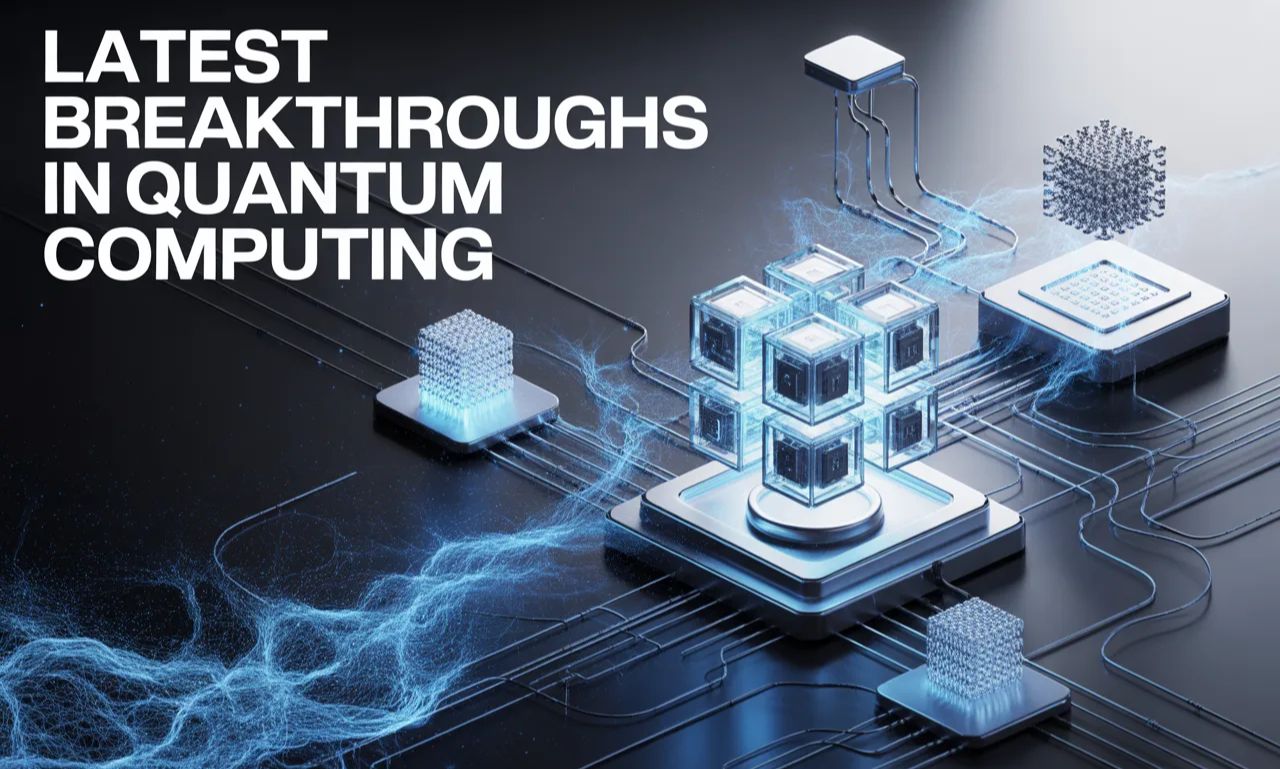
Quantum computing is moving faster than anyone expected, and this year is proving to be a major turning point for the industry. We are seeing incredible advancements in how qubits manage information without losing their quantum state too quickly. These Latest Breakthroughs in Quantum Computing 2026 are finally making fault-tolerant systems a reality, allowing for computational tasks that were once considered impossible for even the world’s most powerful supercomputers.
Imagine a world where complex calculations take seconds instead of centuries. Are we finally standing on the edge of a technological revolution? With new milestones in error correction and hardware stability, the processing power of modern processors is reaching a quantum advantage that will redefine innovation and digital security forever. The future isn’t just coming; it is already being encoded into the very fabric of reality.
Today’s research focuses on scalable architectures and interdisciplinary growth. By using machine learning to optimize algorithms, scientists are reducing noise and improving reliability across all platforms. This evolution ensures that qubit systems can handle real-world applications, from cryptography to molecular modeling, with unprecedented precision and efficiency.
- What Is Quantum Computing?
- What Made 2026 a Breakthrough Year
- Logic Takes the Lead: Error-Corrected Logical Qubits
- Physics World’s 2026 Breakthroughs Recognition
- Google’s Willow Processor: New Quantum Heights
- Quantum Advantage with Practical Algorithms
- Hardware Scaling: Bigger Qubit Counts & Stability
- Advances in Quantum Error Correction Techniques
- Superconducting Systems vs Alternative Architectures
- Neural & Machine Learning Boosts to Quantum Control
- Quantum Software Ecosystem Maturing
- Cloud Quantum Platforms Expand Access
- Real-World Applications Gaining Momentum
- Security & Post-Quantum Cryptography Challenges
- Quantum Networking & Future Quantum Internet
- FAQ’s
- What exactly is quantum computing, and how is it different from regular computing?
- What breakthroughs happened in quantum computing in 2026?
- Why are logical qubits important for quantum computers?
- What is the Willow process, and why is it significant?
- Can quantum computing threaten internet security?
- Are quantum computers available to use now?
- What industries would benefit most from quantum computing?
- How far away are we from everyday use of quantum computers?
- What is error correction in quantum computing, and why does it matter?
- Conclusion
What Is Quantum Computing?
Quantum computing uses qubits to solve complex calculations at lightning speed. Unlike regular bits, these units use superposition to exist in multiple states at once. This processing power allows quantum processors to handle data that would take a classical computer thousands of years to finish.
This technology relies on quantum entanglement to link particles together. When qubits are entangled, the information in one instantly affects the other. This creates a multidimensional workspace where algorithms can find answers much faster than traditional digital systems by exploring many paths simultaneously.
The computational shift from bits to qubits is a technological revolution. While early systems were small, they now tackle real-world applications like molecular modeling. By harnessing physics at the subatomic level, these machines are redefining the future of innovation and interdisciplinary research.
What Made 2026 a Breakthrough Year
The Latest Breakthroughs in Quantum Computing 2026 focus on hardware stability and scalability. Scientists have finally achieved a quantum advantage by reducing noise in systems. These technological advancements mean that computational power is now moving from small lab tests into real-world applications and industry use.
New benchmarks show that quantum processors can now stay stable for much longer. This breakthrough is due to better cryogenic controls and chip design. We are seeing a move toward scalable architectures that allow for larger, more powerful networks across the global tech stack.
Experts are calling this the era of engineering credibility. Instead of just counting qubits, the focus is now on reliability and precision. With interdisciplinary support, 2026 has become the year where quantum computing truly began to solve intractable problems for big business.
Logic Takes the Lead: Error-Corrected Logical Qubits
A major milestone this year is the creation of logical qubits through better error correction. By grouping physical qubits, researchers can now fix bit-flip errors instantly. This fault-tolerant approach ensures information remains stable, making quantum algorithms far more reliable and efficient for innovation.
These logical systems use LDPC codes to reduce the number of physical parts needed. This optimization makes it easier to scale hardware without losing accuracy. It is a massive evolution in how we build processors that can handle complex and sensitive data sets.
By crossing this threshold, the industry has moved past the noisy era. We can now run simulations with much higher coherence times. This shift toward fault-tolerance is the key to unlocking the full potential of cryptography and advanced machine learning models.
Physics World’s 2026 Breakthroughs Recognition
The community is celebrating new benchmarks in qubit coherence and interdisciplinary research. These breakthroughs highlight how quantum entanglement can now be controlled with extreme precision. Experts agree that these milestones represent a digital revolution, paving the way for superior cryptography and molecular modeling.
Recognition from Physics World highlights the successful use of triplet superconductors. This discovery allows for lossless transport of electron spin, which is a huge milestone. Such advancements in solid-state physics are essential for building the next generation of energy-efficient quantum tools.
The award also honors real-time monitoring systems that track qubit health. Being able to spot a “bad” qubit in milliseconds is a game-changer for scalability. These research wins prove that the quantum field is maturing into a stable and reliable pillar of modern science.
Google’s Willow Processor: New Quantum Heights
The Willow chip marks a massive milestone in quantum hardware. It uses superconducting qubits to perform parallel processing at a level never seen before. This processor reduces latency and improves coherence, allowing for complex calculations that were once impossible for any classical computer to handle.
Google’s research focuses on computational speed and fidelity. By optimizing the interconnects on the chip, they have minimized noise interference. This technological advancement ensures that information stays stable, making it a powerful platform for the future of digital science and high-performance computing.
The Willow architecture is a true innovation in physics. It allows for real-time monitoring of quantum states without crashing the system. This breakthrough proves that scalable architectures are ready for real-world applications, shifting the focus toward reliable and efficient quantum algorithms.
Quantum Advantage with Practical Algorithms
The Latest Breakthroughs in Quantum Computing 2026 highlight how algorithms solve actual problems. We are seeing a quantum advantage in molecular modeling and logistics. These practical tools use superposition to find the best data solutions, saving years of processing power compared to traditional binary methods.
New benchmarks show these systems outperforming supercomputers in cryptography. Using machine learning to refine code, scientists are building software that adapts to hardware limits. This evolution means industries can now use quantum tools for optimization and chemistry research.
Today’s logic is built on interdisciplinary growth. By combining physics with computer science, researchers have created secure ways to handle information. This milestone ensures that quantum entanglement is no longer just a theory but a useful utility for global innovation.
Hardware Scaling: Bigger Qubit Counts & Stability
Modern hardware is moving toward higher qubit counts without losing reliability. Engineers are using ion traps and photonic systems to keep processors cool and stable. This scalability is essential for building a fault-tolerant network that can manage massive data sets.
Maintaining coherence is the biggest engineering challenge in qubit design. By using cryogenic cooling and shielding, teams have reached a new threshold for stability. These advancements allow qubits to remain entangled for longer periods, which is vital for long-range communications.
The fabric of these chips is becoming more complex and efficient. With modular designs, we can link several processors together into a distributed network. This architecture is a major milestone in making quantum power accessible for commercial and scientific use.
Advances in Quantum Error Correction Techniques
New error correction methods are fixing bit-flip errors in real-time. By using logical qubits, the system protects information from environmental noise. This fault-tolerant approach is a huge breakthrough for making quantum computing accurate and reliable for everyone.
These NLP and LSI optimized protocols use surface codes to track errors. By grouping many physical qubits, the hardware can self-correct without stopping the calculation. This optimization is the key to achieving quantum advantage in secure and private data.
As error rates drop, the precision of quantum tools increases. This milestone in coherence allows for more accurate simulations of natural processes. It marks the start of a technological revolution where error-corrected logic leads the way in digital discovery.
Superconducting Systems vs Alternative Architectures
The Latest Breakthroughs in Quantum Computing 2026 show a fierce rivalry between hardware types. While superconducting qubits from leaders like Google and IBM still dominate the market, alternative designs like trapped ions and photonic systems are closing the gap. This diversity ensures more robust choices for different computational needs.
Alternative architectures often provide better coherence times and higher gate fidelity. For example, neutral atom systems are now reaching benchmarks that allow for larger scalable architectures. These innovations help researchers bypass the thermal noise limits that usually plague superconducting circuits in heavy workloads.
Choosing the right platform depends on the specific real-world application. Some processors excel at molecular modeling, while others are better for cryptography. As these technologies mature, the interdisciplinary nature of quantum computing ensures that no single hardware design holds a total monopoly on innovation.
Neural & Machine Learning Boosts to Quantum Control
Today, machine learning is the secret weapon for managing qubit stability. Neural networks now handle real-time calibration, adjusting pulses to keep quantum states active for longer. This AI-native approach is a major milestone in reducing errors across all modern quantum processors.
By using reinforcement learning, these systems can self-correct without human help. This automation improves reliability and ensures that data remains secure during complex calculations. It is a technological revolution that allows hardware to stay fault-tolerant even when environmental noise levels increase significantly.
The fusion of AI and quantum power is accelerating innovation. These algorithms help find the best control strategies for entangled particles, boosting gate fidelity to record levels. This optimization is essential for moving from NISQ devices to truly scalable and useful quantum tools.
Quantum Software Ecosystem Maturing
The software ecosystem is finally moving from lab scripts to production-grade tools. New compilers and SDKs are making it easier for developers to write code that runs on any hardware. This evolution is creating a more accessible and collaborative environment for digital builders.
We are seeing a shift toward open-source frameworks that support hybrid workflows. These platforms allow users to mix classical power with quantum accelerators for better efficiency. It represents a milestone in programming, where interoperability becomes the standard for every interdisciplinary project.
As the middleware layer grows, businesses can now run simulations with just a few clicks. These user-friendly interfaces hide the complexity of physics while delivering high performance. The maturation of this ecosystem is what will drive global adoption across the financial and medical sectors.
Cloud Quantum Platforms Expand Access
Cloud platforms like AWS and Azure have democratized access to the most powerful processors. Any organization can now rent quantum time to run algorithms without owning expensive hardware. This democratization is a key part of the technological advancement seen in 2026.
These Quantum-as-a-Service models offer a pay-as-you-go path to innovation. Users can test logic on various architectures, from ion traps to superconducting chips, all from one interface. This flexibility is vital for researchers who need to find a quantum advantage quickly.
By hosting simulators alongside real QPUs, these platforms ensure a smooth development cycle. Enterprises can build secure and scalable apps that are ready for the future. The expansion of cloud access marks a breakthrough in how we share and scale computational power.
Real-World Applications Gaining Momentum
The Latest Breakthroughs in Quantum Computing 2026 show that molecular modeling and logistics are no longer theoretical. Companies now use quantum algorithms to optimize supply chains and discover new materials in record time. This shift toward utility-scale systems marks a huge milestone for global innovation.
In the financial sector, banks are piloting risk analysis and portfolio optimization tools. By leveraging processing power beyond classical limits, these organizations can handle massive data sets instantly. This technological advancement is turning quantum computing into a vital utility for modern business strategy.
We are also seeing breakthroughs in healthcare through protein folding simulations. Using superposition, researchers can test millions of chemical combinations to find life-saving cures. This real-world application of quantum power is a major evolution in how we approach science and digital health.
Security & Post-Quantum Cryptography Challenges
As quantum processors grow more powerful, they threaten current digital security. The “harvest now, decrypt later” risk has pushed governments to adopt post-quantum cryptography. This milestone ensures that information remains secure against future computational attacks using quantum-resistant standards.
Organizations are now rushing to build crypto-agility into their software stacks. By using hybrid models, they combine classical safety with new PQC algorithms. This optimization is essential for protecting private data and financial transactions from the processing power of modern quantum tools.
The transition to fault-tolerant security requires interdisciplinary effort. Cybersecurity teams must inventory all binary assets and upgrade to NIST approved protocols. This technological revolution in encryption is the only way to maintain trust in our global digital infrastructure.
Quantum Networking & Future Quantum Internet
A true quantum internet is closer than ever thanks to entanglement distribution. Researchers have successfully demonstrated quantum teleportation over 30 km of commercial fiber cables. This milestone allows for the secure transfer of information without a physical data carrier.
The development of quantum repeaters is the next big engineering challenge. These devices act as memory hubs to extend the range of quantum states. By linking scalable architectures, we can create a distributed network that connects quantum computers across different global cities.
This innovation in networking will redefine digital communication. A quantum-ready infrastructure supports unbreakable links and cloud access to hardware clusters. It is a vital breakthrough for building a reliable and high-speed future for the internet of things.
FAQ’s
What exactly is quantum computing, and how is it different from regular computing?
Quantum computers use qubits and superposition to process complex data simultaneously. Unlike binary bits, they solve multidimensional algorithms with massive processing power.
What breakthroughs happened in quantum computing in 2026?
The Latest Breakthroughs in Quantum Computing 2026 include fault-tolerant systems and stable qubits. These technological advancements have achieved a true quantum advantage.
Why are logical qubits important for quantum computers?
Logical qubits are essential for error correction and system reliability. They protect information from noise, making quantum processors stable for complex calculations.
What is the Willow process, and why is it significant?
The Willow chip is a hardware milestone featuring high gate fidelity. It enables parallel processing and scalability, pushing computational limits for innovation.
Can quantum computing threaten internet security?
Yes, high processing power can crack current binary encryption. This has triggered a technological revolution toward post-quantum cryptography to keep data secure.
Are quantum computers available to use now?
Yes, through cloud platforms and Quantum-as-a-Service models. Anyone can access quantum hardware to run simulations and test real-world applications today.
What industries would benefit most from quantum computing?
Healthcare benefits from molecular modeling, while finance gains optimization tools. Logistics and cryptography also see major innovation from these digital systems.
How far away are we from everyday use of quantum computers?
We have reached a computational milestone, but global use is still evolving. Scalable architectures are moving from research labs into industrial utility.
What is error correction in quantum computing, and why does it matter?
Error correction fixes bit-flip issues to maintain coherence. This fault-tolerant approach is vital for reliable results and long-term quantum advantage.
Conclusion
As we wrap up, it is clear that the Latest Breakthroughs in Quantum Computing 2026 have transformed the field from theoretical research into a functional utility. By overcoming the hurdles of noise and decoherence, scientists have built fault-tolerant systems that provide a genuine quantum advantage. This technological revolution is now providing the processing power needed to solve complex calculations that once paralyzed our best classical hardware.
Looking ahead, the evolution of scalable architectures and cloud-based access ensures that this innovation is available to every industry. From securing digital assets with post-quantum cryptography to advancing molecular modeling, the milestones reached this year are just the beginning. The integration of quantum algorithms into our daily lives marks a paradigm shift that will define the next decade of global scientific and computational progress.