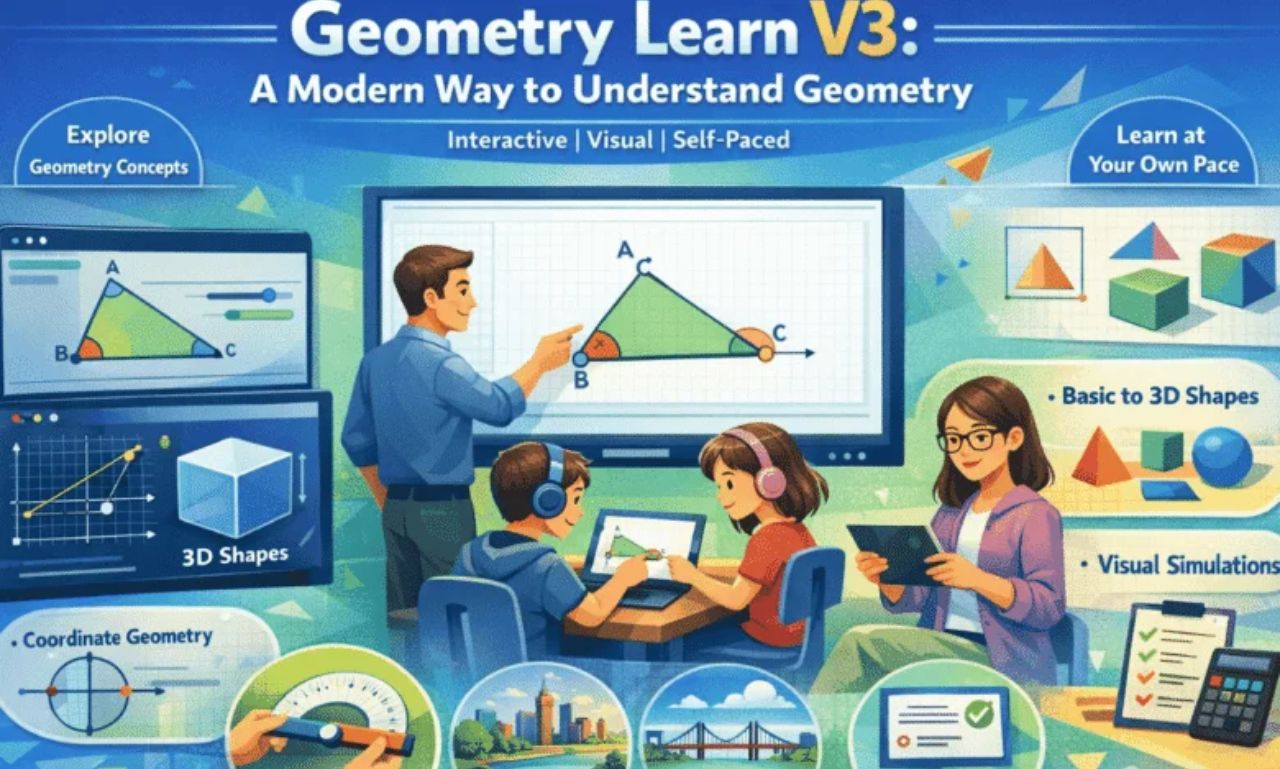
Welcome to the future of digital mathematics! If you are tired of staring at confusing shapes and complex formulas, Geometry Learn V3 is here to change your perspective. This interactive learning platform uses spatial visualization to help you master angles, polygons, and theorems effortlessly. By blending educational technology with clear instructions, we make sure every student gains a deep conceptual understanding of math.
Ever felt like triangles and circles were a foreign language? You aren’t alone, but you are about to find a solution. Our latest software update provides a user-friendly interface designed to turn your academic frustration into genuine confidence. Stop struggling with old textbooks and start experiencing a modern, dynamic curriculum that actually sticks.
Ready to sharpen your problem-solving skills today? Our adaptive algorithms personalize your study sessions, focusing on geometric proofs and coordinate planes. This intuitive tool ensures you grasp mathematical logic quickly. Let’s dive in and unlock your full cognitive potential with this innovative approach!
- What Does Geometry Learn V3?
- Evolution of Geometry Learning
- Core Principles Behind Geometry Learn V3
- Visual Learning First
- Concept Before Formula
- Self-Paced Progress
- Key Topics Covered in Geometry Learn V3
- Basic Geometry Foundations
- Two-Dimensional Shapes
- Three-Dimensional Geometry
- Coordinate Geometry
- Why Geometry Learn V3 Is Effective for Students
- Reduces Math Anxiety
- Encourages Active Learning
- Builds Real-World Connections
- Geometry Learn V3 for Teachers and Educators
- Flexible Teaching Tool
- Geometry Learn V3 for Self-Learners
- Clear Learning Path
- Instant Feedback
- The Role of Technology in Geometry Learn V3
- Interactive Diagrams and Simulations
- Accessibility and Convenience
- Challenges and Considerations
- Balance With Traditional Practice
- Guidance Still Matters
- Conclusion
What Does Geometry Learn V3?
At its essence, this system is a holistic educational ecosystem designed to bridge the gap between “seeing” a shape and “understanding” its properties. It functions as a digital tutor that identifies a student’s current proficiency level and adapts the complexity of problems in real-time. Unlike traditional software that simply acts as a digital textbook, this version actively engages with the user’s logic, providing hints and visual cues that guide them toward a solution rather than just handing it to them.
Evolution of Geometry Learning
Historically, learning geometry meant memorizing a list of postulates from a dusty book. If you couldn’t visualize a cylinder’s volume in your head, you were likely to fail the exam. The evolution of this field has moved from static 2D drawings to dynamic, manipulatable environments. In 2026, the focus has shifted entirely toward “Kinesthetic Digital Learning,” where the act of dragging a vertex or rotating a plane provides the sensory input necessary for the brain to encode the information deeply.
Core Principles Behind Geometry Learn V3
The success of any educational tool depends on the philosophy that drives its design. This platform is built on three foundational pillars that prioritize the human element of learning over the mechanical nature of math.
Visual Learning First
The brain processes visual information significantly faster than text. By presenting a parallelogram or a trapezoid as a dynamic object before defining its properties, the system allows the student to build an “image-first” mental map. This approach ensures that when the technical term is finally introduced, the student already has a visual reference to attach it to.
Concept Before Formula
Too many students treat formulas like magic spells—they say the words but don’t know why they work. This system flips the script. Before teaching the formula for the area of a circle, the software might lead a student through an exercise of “slicing” the circle into infinite tiny triangles. By understanding the concept of infinitesimal calculus in a basic form, the formula $A = \pi r^2$ becomes a logical conclusion rather than a random rule to memorize.
Self-Paced Progress
Every learner has a unique “Aha!” moment. Forced progression through a curriculum is the leading cause of students falling behind. This platform uses adaptive algorithms to ensure that a user does not move on to congruent triangles until they have demonstrated 100% mastery of angle relationships.
Key Topics Covered in Geometry Learn V3
The curriculum is designed to be exhaustive, taking a student from the most basic definitions to complex spatial analysis.
Basic Geometry Foundations
Everything starts with the “undefined terms” of geometry: points, lines, and planes. The platform uses high-definition simulations to show how these invisible concepts form the building blocks of everything in our physical world.
Two-Dimensional Shapes
Here, students explore the world of polygons, quadrilaterals, and circles. The software includes interactive tools to measure perimeter, area, and interior angles.
- Triangles: Isosceles, Equilateral, and Scalene.
- Quadrilaterals: Squares, Rectangles, and Rhombuses.
- Curvature: Understanding the relationship between diameter and circumference.
Three-Dimensional Geometry
This is where the platform truly shines. By using 3D rendering, students can “walk through” a polyhedron or calculate the surface area of a sphere by peeling it like an orange. The transition from 2D to 3D is seamless, helping students understand how a 2D net folds into a 3D solid.
Coordinate Geometry
By integrating algebra with geometry, the software teaches students how to map shapes onto a Cartesian plane. This includes calculating the midpoint, the distance between points, and the slope of a line.
Why Geometry Learn V3 Is Effective for Students
Effectiveness is measured by more than just test scores; it is measured by a reduction in “math trauma” and an increase in curiosity.
Reduces Math Anxiety
The “Instant Feedback” loop is a powerful psychological tool. When a student makes a mistake, the software offers a gentle correction immediately. This prevents the “spiral of frustration” that occurs when a student completes an entire homework assignment incorrectly only to find out days later.
Encourages Active Learning
Students are not passive observers. They are the “architects” of their own learning. Whether they are constructing a bisector or proving a theorem, they are actively clicking, dragging, and experimenting.
Builds Real-World Connections
The system frequently presents “Applied Geometry” scenarios. For example, it might ask a student to calculate the amount of paint needed for a specific room or the optimal angle for a solar panel. These contextual examples prove that math is not just an academic exercise but a vital life skill.
Geometry Learn V3 for Teachers and Educators
Educators in 2026 use this platform as a force-multiplier in the classroom. It doesn’t replace the teacher; it empowers them.
| Feature | Educational Benefit |
| Real-Time Analytics | Teachers see exactly which student is struggling with which concept. |
| Customized Assignments | Teachers can “flip the classroom” by assigning interactive labs at home. |
| Automated Grading | Frees up hours of time for one-on-one student mentorship. |
Flexible Teaching Tool
Whether used for a whole-class demonstration on a smartboard or for individualized lab time, the software adapts to any teaching style. It supports differentiated instruction, allowing the teacher to provide more challenging work for advanced students while the software supports those who need extra help.
Geometry Learn V3 for Self-Learners
For those studying outside a traditional classroom, this tool acts as a lighthouse, providing a clear path through a complex subject.
Clear Learning Path
Self-learning can often feel like being lost in a forest. The linear progression modules ensure that you are always building on top of what you just learned. There are no “knowledge gaps” left behind.
Instant Feedback
For a self-learner, the software is the teacher. The AI-driven hints analyze your specific mistake—such as a calculation error versus a conceptual misunderstanding—and provide the exact piece of information needed to get back on track.
The Role of Technology in Geometry Learn V3
We live in an age where technology should simplify, not complicate. The software uses high-end graphical processing to ensure that simulations run smoothly on any device.
Interactive Diagrams and Simulations
A static diagram is a snapshot; a simulation is a movie. When a student can see a sine wave generated by a rotating circle, the connection between geometry and trigonometry becomes crystal clear. These simulations are “sandbox” environments where students are encouraged to “break” things to see what happens.
Accessibility and Convenience
In 2026, the software is fully cloud-native. A student can start a proof on their laptop at school and finish it on their phone during the bus ride home. The user interface is designed for high accessibility, including voice commands and high-contrast modes for students with visual impairments.
Challenges and Considerations
While technology is a powerful ally, it must be balanced with traditional skills to create a well-rounded mathematician.
Balance With Traditional Practice
Despite the beauty of digital tools, the “muscle memory” of solving a problem with a pencil and paper still has cognitive value. We recommend using the software to build the concept, then practicing the long-form manual steps to ensure total fluency.
Guidance Still Matters
Even the best AI cannot replace the inspiration provided by a human mentor. The software is a tool, but the drive to learn comes from the environment. Parents and teachers should remain involved to celebrate successes and provide emotional support during difficult modules.
Conclusion
The transition to Geometry Learn V3 represents a major milestone in how we communicate mathematical truths to the next generation. By prioritizing visual logic, providing an adaptive and supportive environment, and grounding abstract concepts in real-world utility, the platform removes the “wall” that so many people hit when studying math. In 2026, we no longer ask students to simply memorize; we invite them to explore, visualize, and master the very geometry that shapes our universe.