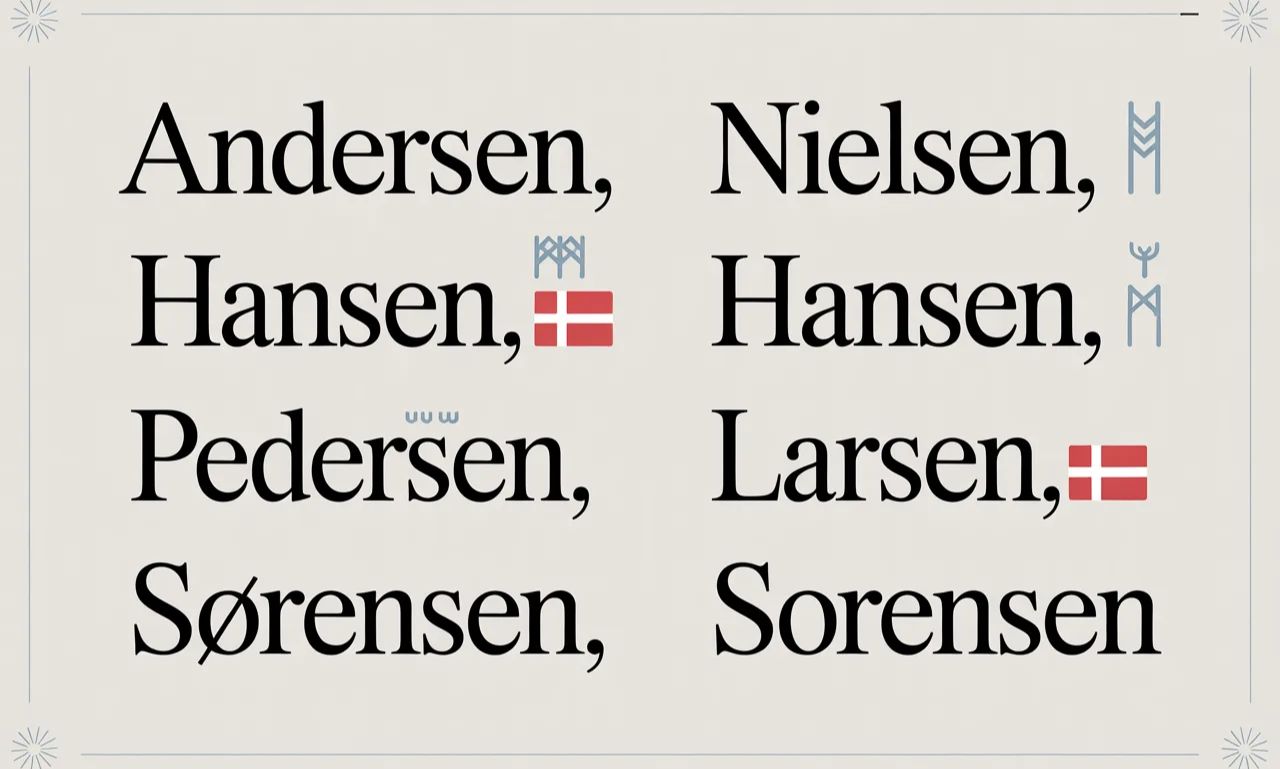

Exploring the history of family names in Denmark is like opening a window into the past. Many people find that Danish Surnames carry stories of ancestral roots and ancient traditions passed down through generations. Whether you are researching your genealogy or simply curious about Scandinavian culture, understanding these names helps connect you to a rich viking heritage. It is a fascinating journey of identity and discovery.
Have you ever wondered if your last name holds a secret bloodline to royalty or a fearless explorer? Most people assume all Nordic names are simple, but the truth is far more mysterious. Behind every common patronymic suffix lies a hidden lineage waiting to be uncovered. Are you ready to dive into the enigmatic world of your forefathers?
The modern naming conventions in Denmark have evolved significantly over the centuries. Today, hereditary titles blend perfectly with cultural history to create a unique nomenclature. By studying these etymology patterns, we can better understand the linguistic shifts that shaped the beautiful and diverse Denmark we see today.
15 Most Common Danish Last Names (With Meanings)
In Denmark, a handful of family names carry the weight of an entire nation’s history. These iconic titles emerged from a rigid naming law that essentially “paused” time, turning temporary nicknames into permanent legacies that millions of people share today.
| Rank | Surname | Approx. Bearers* | Meaning |
| 1 | Nielsen | ~222,000 | Son of Niels. Derived from Nicholas, translating to “victory of the people.” |
| 2 | Jensen | ~219,000 | Son of Jens. Jens is the Danish form of John, meaning “God is gracious.” |
| 3 | Hansen | ~186,000 | Son of Hans. A shortened version of Johannes, meaning “gift from God.” |
| 4 | Andersen | ~144,000 | Son of Anders. The Danish take on Andrew, which signifies “masculine” or “brave.” |
| 5 | Pedersen | ~141,000 | Son of Peder. Peder is the Scandinavian Peder (Peter), meaning “rock” or “stone.” |
| 6 | Christensen | ~107,000 | Son of Christen. A local variant of Christian, meaning “follower of Christ.” |
| 7 | Larsen | ~102,000 | Son of Lars. Derived from Laurentius, meaning “crowned with laurel.” |
| 8 | Sørensen | ~98,000 | Son of Søren. Based on Severinus, meaning “stern,” “serious,” or “strict.” |
| 9 | Rasmussen | ~84,000 | Son of Rasmus. Short for Erasmus, translating to “beloved” or “desired.” |
| 10 | Jørgensen | ~78,000 | Son of Jørgen. The Danish form of George, meaning “farmer” or “earth-worker.” |
| 11 | Petersen | ~69,000 | Son of Peter. A common variation of Pedersen, rooted in the Greek word for rock. |
| 12 | Madsen | ~58,000 | Son of Mads. Mads is a nickname for Mathias, meaning “gift of Jehovah.” |
| 13 | Kristensen | ~56,000 | Son of Kristen. A spelling variation of Christensen with the same spiritual roots. |
| 14 | Olsen | ~43,000 | Son of Ole. Derived from Olaf, meaning “ancestor’s descendant” or “relic.” |
| 15 | Thomsen | ~37,000 | Son of Thomas. Rooted in the Aramaic word for “twin.” |
Non-Patronymic Danish Surnames and Their Origins
While patronymics dominate the landscape, a significant portion of the Danish population carries names that reflect the soil beneath their feet or the tools in their hands. These surnames act as historical markers, capturing a moment when a family’s identity became inseparable from their physical environment or their daily labor.
Occupational Surnames
In the heart of every medieval village, your job was your identity. These surnames were born in the heat of the forge or the dust of the mill, surviving long after the original tradesmen laid down their tools for the final time.
- Møller – Meaning: The Miller. This is the most prevalent non-patronymic name, belonging to those who controlled the village grain supply.
- Smed – Meaning: The Smith. A strong, rhythmic name for the metalworker who was essential for making tools and horseshoes.
- Fisker – Meaning: The Fisherman. Given the vast Danish coastline, this name honors those who made their living from the cold North Sea.
- Kusk – Meaning: The Coachman. A specialized title for those who handled horse-drawn carriages and transportation for the upper class.
- Bonde – Meaning: The Farmer. More than just a job, it originally referred to a “free holder” who owned and worked his own land.
- Skytte – Meaning: The Marksman or Archer. A title for a skilled hunter or a guard responsible for protecting a lord’s estate.
- Gartner – Meaning: The Gardener. Often used for those who managed the intricate floral and vegetable gardens of Danish manor houses.
Topographic Surnames
If you weren’t named for your father or your work, you were likely named for your home. These nature-based titles describe the beautiful, windswept geography of Denmark, turning hills, woods, and islands into permanent family identities that last centuries.
- Holm – Meaning: Small Island. An evocative name for someone living on a patch of dry land surrounded by water or marsh.
- Lund – Meaning: The Grove. A poetic surname referring to a family whose home was nestled near a small, sacred wood.
- Dahl – Meaning: The Valley. This name describes a person residing in a low-lying area, offering a sense of peace and shelter.
- Skov – Meaning: The Forest. A direct and earthy connection to the ancient woodlands that once covered much of the Danish peninsula.
- Berg – Meaning: The Hill or Mountain. Though Denmark is relatively flat, any significant elevation was enough to earn this sturdy title.
- Strand – Meaning: The Beach. Perfect for families dwelling along the sandy, salty edges of the Baltic or North Seas.
- Kjær – Meaning: The Marsh. Derived from Old Norse, this name marks a family whose roots were in the fertile, wet wetlands.
Mini-Glossary of Common Roots
Understanding the “building blocks” of Danish names can help you decode almost any surname you encounter. These suffixes and prefixes were frequently combined to create specific descriptions of family estates.
- -gaard / -gård: Meaning “farm” or “estate.” (e.g., Nygaard = New Farm).
- -vig: Refers to a “bay” or “inlet.” (e.g., Sandvig = Sandy Bay).
- -by: The standard term for “town” or “village.” (e.g., Kirkeby = Church Town).
- -hede: Describes a “heath” or “moorland,” typical of the Jutland landscape.
- -bro: Simply means “bridge,” indicating a home located near a vital crossing.
Old and Ancient Danish Last Names: 19 Forgotten Gems
Before the law stepped in to freeze family names into the “-sen” patterns we recognize today, Denmark was a land of colorful “bynames.” These weren’t just labels; they were vivid descriptors of a person’s character, physical appearance, or legendary deeds. Digging into these ancient gems feels like uncovering a hidden map of the Viking spirit, where names were earned through reputation rather than just inherited by birth.
Rare and Ancient Surnames Still in Use
While many old bynames faded into the mists of history, a few resilient titles survived the transition to modern surnames. These rare finds offer a direct link to the Old Norse tongue and the rustic farmsteads of the Middle Ages, standing out as unique alternatives to the common patronymic crowd.
- Kierkegaard – Meaning: Church Yard. This hauntingly beautiful name refers to a family living near the village cemetery or church grounds.
- Ravn – Meaning: The Raven. A powerful bird in Norse mythology, symbolizing wisdom and the watchful eyes of the god Odin.
- Hviid – Meaning: White. Originally an ancient nickname for someone with striking white hair or an exceptionally fair complexion.
- Brodersen – Meaning: Son of Brother. Based on the Old Danish name “Broder,” which treated the familial bond as a formal first name.
- Aagaard – Meaning: River Farm. Describes a homestead built on the fertile banks of a flowing stream or river.
- Wulff – Meaning: The Wolf. A name that carries the primal strength and predatory grace of one of Scandinavia’s most respected animals.
- Falk – Meaning: The Falcon. Represents sharp vision and agility, likely used for families associated with the noble sport of falconry.
- Bang – Meaning: Field or Terraced Ground. Derived from Old Norse, it describes the physical layout of an ancestor’s sloping farmland.
- Gammelgaard – Meaning: Old Farm. A title for families who stayed on the original, ancestral estate while others moved to newer lands.
- Høeg – Meaning: The Hawk. Similar to Falk, this avian name suggests a person with a keen eye or a commanding presence.
- Bjerregaard – Meaning: Hill Farm. A specific place-name for an estate perched on one of Denmark’s rolling, elevated landscapes.
- Friis – Meaning: The Frisian. An ethnic surname marking a family that originally migrated from the Frisia coastal regions.
- Abildgaard – Meaning: Apple Orchard Farm. A refreshing and pastoral name for those living among the blooming fruit trees.
- Stærk – Meaning: The Strong. A direct and bold byname given to a man known for his immense physical power or resilience.
- Hoppe – Meaning: To Leap or The Mare. Depending on the dialect, it either described a person’s gait or a family involved with horses.
27 Rare and Unique Danish Last Names You Should Know
Beyond the repetitive sea of “-sen” suffixes lies a collection of hidden gems that most outsiders—and even many Danes—rarely encounter. These unique surnames act as historical anchors, often pointing to a specific family estate, a localized dialect, or a niche trade that never expanded into the mainstream. Choosing one of these names is like wearing a piece of rare Danish jewelry; it stands out for its craftsmanship and its story.
Rare Danish Surnames with Historical or Regional Roots
These names are often tied to the specific “micro-geography” of Denmark. They describe the intimate corners of the kingdom, from isolated islands to specific historical regions, ensuring that the bearer carries their home wherever they travel.
- Blichfeldt – Meaning: Shining Field. A poetic name likely referring to a bright, open clearing in the countryside.
- Juul – Meaning: Yule or Wheel. A name with ancient festive roots, possibly referring to a family born during the winter solstice.
- Kaas – Meaning: Chalk or Limestone. A noble surname historically associated with families from regions with distinct rocky soil.
- Dorph – Meaning: The Village. An old, elegant variation of the word for a small settlement or hamlet.
- Grønbech – Meaning: Green Stream. An evocative nature name for an ancestor living by a lush, mossy brook.
- Seidenfaden – Meaning: Silk Thread. An incredibly rare and delicate name, suggesting a history of luxury or refined craftsmanship.
- Kjærgaard – Meaning: Marsh Farm. A specific compound name combining the low-lying wetlands with a family estate.
- Steen – Meaning: Stone. While simple, it remains a sturdy, rare alternative to the more common patronymics.
- Pontoppidan – Meaning: Bridge Place. A Latinized version of “Broby,” often adopted by scholars and clergy in the 17th century.
Occupational Surnames That Stayed Rare
While “Miller” and “Smith” became common worldwide, some Danish trade names remained exclusive. These surnames represent specialized skills or roles within the royal court and law that were never meant for the masses.
- Fenger – Meaning: The Catcher. Possibly an ancient title for a hunter or someone tasked with seizing property or criminals.
- Foged – Meaning: The Bailiff. A surname representing a high-ranking official responsible for law and order in a local district.
- Koch – Meaning: The Cook. Though German in origin, this name was adopted by those running elite kitchens in Danish manor houses.
- Fabricius – Meaning: The Craftsman. Another Latinized trade name, giving a sophisticated flair to the traditional blacksmith or builder.
- Schultz – Meaning: Village Headman. A title for a local leader or constable, showing the influence of Hanseatic trade.
- Skriver – Meaning: The Scribe. A rare and respected name for someone who possessed the valuable skill of literacy and record-keeping.
- Mønt – Meaning: Coin. A rare occupational name likely tied to those working in the royal mint or financial trade.
- Bødker – Meaning: The Cooper. A specialized name for a craftsman who built the barrels essential for Danish beer and salted herring.
- Høker – Meaning: The Grocer or Small Trader. A name for the local shopkeeper who provided essentials to the village.
Diaspora Variants and Adaptations
When Danish families migrated to the Americas or the UK, their names underwent a “linguistic makeover.” These variants represent the bridge between Old World heritage and New World identity, often simplifying the complex Danish vowels.
- Moeller – Adaptation of Møller. The “ø” was swapped for “oe” to help English speakers approximate the pronunciation.
- Sorensen – Adaptation of Sørensen. The soft, throat-based Danish “ø” was flattened into a standard “o.”
- Jorgensen – Adaptation of Jørgensen. A common shift for immigrants to the United States to avoid confusion at immigration ports.
- Baek – Adaptation of Bæk. The Danish “æ” (sounds like “cat”) was converted to the “ae” digraph or “Beck.”
- Hoegh – Adaptation of Høeg. The silent Danish “g” and complex vowel were simplified for easier reading in English.
- Lawson – Adaptation of Laursen. A radical transformation where the Danish patronymic was “translated” into a familiar British-sounding name.
- Knutson – Adaptation of Knudsen. The spelling was adjusted to reflect the hard “k” sound and the English “-son” suffix.
- Nielson – Adaptation of Nielsen. A subtle spelling flip that aligned with the phonetic expectations of North American record-keepers.
- Oleson – Adaptation of Olsen. Adding the “o” helped preserve the long vowel sound of the original Danish name.
Danish Last Names A–Z: 24 Examples by Letter
While it may feel like a sea of -sen endings when you look at a Danish phone book, organizing these names alphabetically reveals the hidden diversity of the language. Some letters are dominated by ancient kings, while others are filled with descriptors of the rugged Jutland landscape. Think of this directory as an atlas of identity, where each letter opens a different chapter of the Nordic story.
Danish Last Names Starting With K
The letter ‘K’ in Denmark is often associated with strength and spiritual history. From names rooted in early Christianity to those tied to the powerful monarchs of the Viking Age, these surnames carry a sense of tradition and permanence.
- Kristensen – Meaning: Son of Kristen. A deeply rooted name referring to a “follower of Christ.”
- Knudsen – Meaning: Son of Knud (Canute). A name tied to royal history, as Knud was a legendary King of Denmark.
- Kirkegaard – Meaning: Church Yard. Famous worldwide due to philosopher Søren Kierkegaard, it marks a family living near a church.
- Kjær – Meaning: The Marsh or Meadow. Derived from Old Norse, it describes a family living by a damp, fertile field.
- Kragh – Meaning: The Crow. A nature-based byname likely given to someone with dark hair or a sharp, watchful nature.
- Krogh – Meaning: The Corner or Bend. Usually refers to a family living at a sharp turn in a road or a bend in a river.
- Kaas – Meaning: Chalk or Limestone. A noble surname originating from families in regions with distinctive rocky soil.
- Kofod – Meaning: Calf’s Foot. An unusual, ancient nickname that eventually became a fixed family surname on the island of Bornholm.
Danish Last Names Starting With S
Names starting with ‘S’ often highlight the physical environment or personal traits. This category features a mix of bold, one-syllable nature names and classic patronymics that reflect the stern, resilient character of the Danish people.
- Sørensen – Meaning: Son of Søren. Based on the name Severinus, which translates to “stern” or “serious.”
- Skovgaard – Meaning: Forest Farm. A scenic compound name for a family estate tucked away in the ancient woods.
- Storm – Meaning: The Storm. A dramatic and powerful surname that originally described a person with a fierce or untamed temperament.
- Schmidt – Meaning: The Smith. While borrowed from German, it is a widespread occupational name for metalworkers in Denmark.
- Steen – Meaning: The Stone. A sturdy name signifying strength and reliability, often used as both a first and last name.
- Stærk – Meaning: The Strong. An old byname celebrating physical power and endurance in the face of hardship.
- Seidenfaden – Meaning: Silk Thread. One of Denmark’s rarest and most elegant names, linked to refined craftsmanship or luxury.
- Simonsen – Meaning: Son of Simon. A traditional biblical patronymic that has remained a staple of Danish identity for centuries.
Danish Last Names Starting With J
The letter ‘J’ is the powerhouse of Danish nomenclature. It houses some of the most common names in the country, reflecting the historical popularity of names like John and George among the Danish peasantry and nobility alike.
- Jensen – Meaning: Son of Jens. Jens is the Danish equivalent of John, making this name mean “God is gracious.”
- Jørgensen – Meaning: Son of Jørgen. Jørgen is the local form of George, which literally means “earth-worker” or “farmer.”
- Johansen – Meaning: Son of Johan. Another variation of the “Son of John” lineage, common throughout the Nordic regions.
- Jespersen – Meaning: Son of Jesper. Jesper is the Danish form of Casper, one of the legendary Three Wise Men.
- Juhl – Meaning: Yule or Christmas. A festive and ancient surname likely given to a family born or established during the winter holidays.
- Juul – Meaning: The Wheel or Yule. A noble variant of Juhl, sometimes symbolizing the cycle of the seasons or the sun.
- Jelling – Meaning: From Jelling. A rare locational name tied to the historic town that served as the seat of the first Danish kings.
- Jantzen – Meaning: Son of Jan. A variation of Jensen influenced by Dutch or Low German naming traditions.
Famous Danish Last Names in History and Culture
While millions of people share common endings, a few specific Danish Surnames have transcended the phone book to become global symbols of excellence. These names belong to the visionaries, philosophers, and innovators who shaped how we view the world today. When you hear these names, you aren’t just hearing a family title; you are hearing the echo of a legacy that has traveled far beyond the borders of Scandinavia.
Icons of Thought and Art
These surnames are synonymous with the intellectual and creative spirit of Denmark. They represent the “Golden Age” of Danish culture and continue to inspire modern storytellers and theologians.
- Andersen – Hans Christian Andersen. The world’s most famous fairy tale author. While his name literally means “Son of Anders,” it has become a global brand for imagination, giving us classics like The Little Mermaid and The Snow Queen.
- Kierkegaard – Søren Kierkegaard. Often cited as the father of existentialism, his name means “Church Yard.” It serves as a fittingly contemplative and haunting label for a man who spent his life exploring the depths of the human soul and faith.
- Blixen – Karen Blixen. Known by her pen name Isak Dinesen, she wrote Out of Africa. Her name represents a bridge between Danish heritage and global adventure, embodying the spirit of a true literary pioneer.
Pioneers of Science and Sport
Denmark has consistently punched above its weight in the fields of physics and athletics. These names are etched into the textbooks of science and the halls of fame of international stadiums.
- Bohr – Niels Bohr. A giant of 20th-century atomic physics. His surname is relatively rare and is now tied to the very foundations of how we understand the universe and quantum mechanics.
- Ørsted – Hans Christian Ørsted. The scientist who discovered electromagnetism. His name, derived from an old farmstead, now marks one of the world’s leading renewable energy companies and various scientific units.
- Laudrup – Michael and Brian Laudrup. These brothers are the gold standard of Danish football. Their name is a symbol of grace, precision, and national pride, recognized by fans in every corner of the globe.
- Brahe – Tycho Brahe. A nobleman and astronomer whose precise planetary observations paved the way for modern space exploration. His name carries the weight of ancient aristocracy and scientific rigor.
The Modern Global Influence
In the 21st century, Danish names continue to make waves in architecture and design, proving that the “Danish touch” is still a highly valued nomenclature in the modern world.
- Utzon – Jørn Utzon. The architect behind the Sydney Opera House. His name represents the peak of Danish minimalism and functional beauty, proving that a single family name can define the skyline of an entire continent.
- Ingels – Bjarke Ingels. A contemporary starchitect pushing the boundaries of urban living. His name has become a shorthand for “hedonistic sustainability” and the future of global infrastructure.
FAQ’s
Why do so many Danish names end in “-sen”?
Most names reflect the old patronymic system where “son of” was added to the father’s name. This practice was officially frozen by law in 1828.
Are there any unique naming laws in Denmark today?
Yes, Denmark has strict rules regarding baby names. Parents must choose from a pre-approved list or seek official government permission to ensure the name’s suitability.
What is the most common non-patronymic surname in Denmark?
Møller is the most frequent name not ending in “-sen.” It is an occupational title meaning “miller,” reflecting the importance of grain production in history.
How can I trace my Danish family history?
You should start with the Danish National Archives and digitised census records. These documents provide a clear paper trail of your ancestors’ lives and locations.
Did Danish names change when people immigrated to America?
Yes, many immigrants simplified their spellings at Ellis Island. For example, “ø” often became “oe,” and “-sen” was frequently swapped for the English suffix “-son.”
Conclusion
Ultimately, exploring your roots through family names is a powerful way to bridge the gap between the modern world and the viking heritage of your ancestors. Whether your lineage traces back to the common patronymic tradition of the “-sen” suffixes or the specialized occupational roles of the medieval village, each name serves as a vital identity marker. By understanding these genealogy patterns and the cultural history they represent, you gain a deeper appreciation for the resilient spirit and unique nomenclature that define the people of Denmark today.
Grayson Pike is a pop culture enthusiast and entertainment writer with a sharp eye for celebrity trends. He explores Hollywood stories, interviews, and behind-the-scenes insights, delivering engaging content with a unique voice. Grayson combines curiosity and expertise to keep readers informed and entertained in the fast-paced world of fame.
