
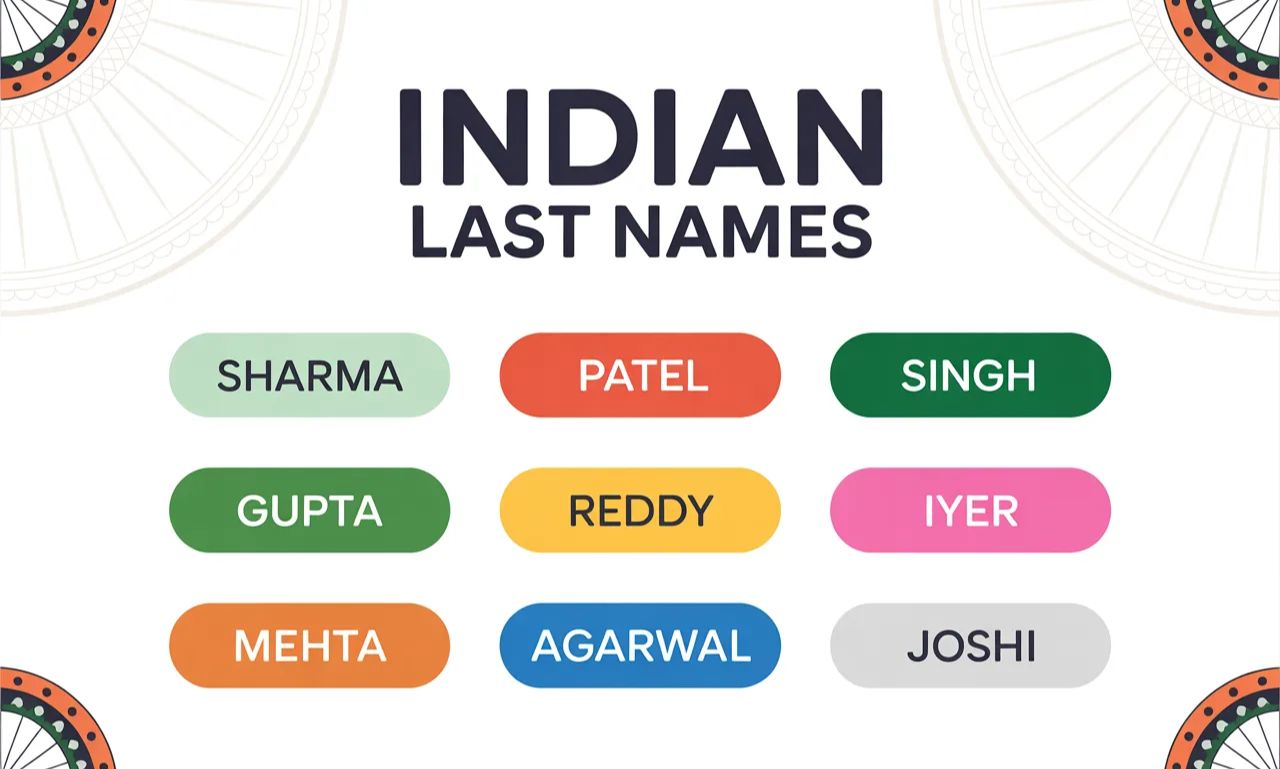

Tracing your family roots through Indian Last Names is like opening a massive, ancient encyclopedia of human history. These surnames act as a genealogical compass, pointing toward specific ancestral villages, traditional occupations, or even sacred community roles. Whether you are searching for a name for your newborn or simply curious about your own identity, understanding these cultural markers reveals the deep, vibrant soul of the entire subcontinent.
Have you ever wondered why some names sound like warrior cries while others feel like a peaceful blessing? The secret lies in a hidden naming code that has survived migrations and colonial shifts for centuries. From the feudal titles of the North to the patronymic initials of the South, your surname is a symbolic key to a world of untold stories.
Modern digital forms and international travel are rapidly changing how we view lineage. Today, many families use hyphenated versions or phonetic simplifications to maintain their heritage in a global era. This guide explores the etymology and regional nuances that make these hereditary titles so unique and significant in our world today.
What Are Indian Last Names?
These hereditary markers act as a genealogical map, pinpointing an ancestor’s geographical origin or ancient occupation. By studying the etymology of these titles, you uncover ancestral stories of migration and social status. They serve as a cultural bridge, connecting modern lineage to centuries of traditional identity and community roots.
In the subcontinent, naming systems vary by region, often reflecting religious affiliation or caste history. Whether through patronymic initials or feudal honorifics, these distinctive labels preserve heritage across generations. They remain significant identifiers in today’s global era, balancing ethnic pride with modern administrative requirements and digital consistency.
31 Most Common Indian Last Names (With Region-Wise Rankings)
Indian surnames are more than just identifiers; they are historical maps. From the rugged terrains of the North to the tropical coasts of the South, these names signal migration, social shifts, and the fascinating way ancestral titles transformed into the modern legal identities we use today.
| Rank | Surname | Meaning & Cultural Essence | Primary Region |
| 1 | Devi | Symbolizing the “Divine Mother” or Goddess; traditionally an honorific. | East (Bihar, West Bengal) |
| 2 | Singh | Derived from the Sanskrit for “Lion,” representing bravery and sovereignty. | North (Punjab, Rajasthan) |
| 3 | Kumar | Signifies “Youth” or “Prince”; used widely as a neutral family name. | Pan-India |
| 4 | Das | Translates to “Devotee” or “One who serves the divine.” | East (Odisha, Bengal) |
| 5 | Kaur | Meaning “Princess”; an egalitarian title for women in the Sikh faith. | North (Punjab) |
| 6 | Yadav | Tracing lineage back to the pastoral Yadu dynasty of ancient lore. | North (UP, Haryana) |
| 7 | Sharma | Denotes “Shelter” or “Prosperity”; linked to scholarly lineages. | North & Central India |
| 8 | Patel | Historically the “Keeper of Records” or the village headman. | West (Gujarat) |
| 9 | Reddy | A title for influential landowning and warrior communities. | South (Andhra, Telangana) |
| 10 | Verma | Meaning “Shield” or “Protection”; a classic noble designation. | North & Central India |
| 11 | Naidu | A title of leadership, often meaning “Governor” or “Chief.” | South (Andhra, Tamil Nadu) |
| 12 | Mehta | Derived from “Great,” usually referring to administrative experts. | West (Gujarat, Rajasthan) |
| 13 | Chowdhury | A prestigious title for “Holders of four shares” or landlords. | East (Bengal, Assam) |
| 14 | Jain | Follower of Jina; signifies a commitment to non-violence and trade. | West & Central India |
| 15 | Mandal | Referring to a “Circle” or “District” administrator or head. | East (Bihar, Bengal) |
23 Indian Last Names by Caste, Class, and Community
Identity in India is often a reflection of what your ancestors did for a living or the social circles they navigated. These surnames serve as echoes of a bygone era, marking the professions, social standing, and communal bonds that defined the Indian subcontinent for centuries.
- Pandey: A branch of the scholarly community specialized in ritualistic wisdom and teaching. (Also known as: Pande, Panday)
- Bhattacharya: High-ranking scholars in Bengal, literally meaning “Teacher of the Sun.” (Alternatives: Bhatt, Bhaduri)
- Tripathi: Those who have mastered the “Three Vedas” or sacred texts. (Variations: Tiwari, Pathak)
- Kurmi: A resilient community known for their deep connection to the earth and agriculture. (Similar to: Mahto, Patel)
- Gowda: Respected heads of farming communities, deeply influential in regional governance. (Often seen as: Gauda)
- Deshmukh: A feudal title meaning “Head of the Province,” common in Maratha history. (Related to: Patil)
- Thakur: A term of respect meaning “Lord” or “Master,” often held by landowners. (Synonyms: Rajput, Singh)
- Iyer: A South Indian community known for their philosophical and priestly traditions. (Alternative: Iyengar)
- Banerjee: A prestigious Bengali title for those originating from the village of Bandoghat. (Similar: Mukherjee, Chatterjee)
- Shetty: Derived from “Sresthi,” meaning a wealthy merchant or influential banker. (Variants: Sethi, Chettiar)
- Agarwal: Traders originating from the ancient city of Agroha; masters of commerce. (Related: Gupta, Bania)
- Joshi: Those who practiced astrology and interpreted the stars for the community. (Also: Jyotishi)
- Chavan: A legendary warrior clan with roots in the medieval military history of Maharashtra. (Linked to: Chauhan)
- Sinha: Another powerful variation of the “Lion” motif, prevalent in Eastern India. (Alternatives: Singha, Sahni)
- Kulkarni: Historically, the village accountants who maintained the local tax records. (Similar to: Deshpande)
19 Indian Last Names by Religion & Language
Faith and mother tongue act as the two primary threads weaving the fabric of an Indian identity. While some names are ancient Sanskrit echoes, others arrived through desert caravans or colonial ships. Understanding these surnames requires looking past the letters to the prayers and dialects that gave them life.
Sikh Surnames
Sikh naming conventions represent a radical shift toward social justice and spiritual sovereignty. In 1699, the tenth Guru introduced a system to dismantle the rigid hierarchy of the past, replacing complex lineage markers with titles of strength and grace that united a diverse community under one banner of equality.
| Surname | Meaning & Heritage | Alternative Expressions |
| Singh | The “Lion”; a mandatory title for men signifying courage. | Sher, Lionhearted, Brave |
| Kaur | “Princess” or “Lioness”; granting women independent status. | Rajkumari, Noblewoman |
| Ahluwalia | Named after the village of Ahlu; a prominent misl (clan). | From Ahlu, Walia |
| Sandhu | A major Jat clan name rooted in ancient ancestral lineages. | Sindhu, Clan of the Sun |
| Gill | Signifies “Prosperity” or “Moisture,” linked to fertile lands. | Thriving, Flourishing |
| Grewal | A powerful clan name representing a deep warrior heritage. | Gaerwal, Highland Dweller |
| Sidhu | Descendants of the legendary ancestor Phul; a royal lineage. | Phulkian, Noble Descent |
| Dhillon | Known as the “First among many”; a resilient farming clan. | Foremost, Leader |
| Bhasin | Derived from the sun; symbolizing brilliance and light. | Radiant, Solar |
| Sethi | A community focused on trade, banking, and commerce. | Banker, Merchant |
| Bajwa | Historically associated with falconry or those who keep hawks. | Falconer, Hawk-eye |
| Chawla | Literally meaning “Rice”; indicating a history of agriculture. | Harvester, Grain-provider |
| Sodhi | The clan of the later Sikh Gurus; spiritual and noble. | Enlightened, Sacred Line |
| Talwar | Meaning “Sword”; a name for those who defended the faith. | Blade, Protector |
| Khalsa | “The Pure”; adopted by those fully initiated into the faith. | Sanctified, Unblemished |
Muslim Surnames
Many Muslim surnames in India serve as a bridge to Islamic history, connecting families to the Prophet’s lineage, noble titles of the Mughal courts, or Persian scholarly traditions. These names often bypass local geography to emphasize a global spiritual connection and a legacy of administrative or religious leadership.
| Surname | Meaning & Heritage | Alternative Expressions |
| Khan | A title of Turkic-Mongol origin meaning “Ruler” or “King.” | Chief, Leader, Monarch |
| Ali | “High” or “Exalted”; honoring the cousin of the Prophet. | Elevated, Noble |
| Ansari | Meaning “The Helpers”; referring to the residents of Medina. | Supporter, Ally |
| Syed | A title for direct descendants of the Prophet Muhammad. | Sayyid, Honorable |
| Farooqi | Linked to Caliph Umar, “The one who distinguishes truth.” | Just, Discriminating |
| Sheikh | Signifies an “Elder” or a man of great religious learning. | Scholar, Mentor |
| Iqbal | Meaning “Good Fortune” or “Prosperity”; a poetic choice. | Lucky, Auspicious |
| Hashmi | Referring to the Banu Hashim clan, the Prophet’s own tribe. | Of Hashim, Clan-bearer |
| Qureshi | Named after the Quraish tribe of Mecca, the keepers of faith. | Tribal, Guardian |
| Siddiqui | “The Truthful”; following the legacy of Abu Bakr as-Siddiq. | Honest, Veracious |
| Mirza | A Persian title meaning “Prince” or “Son of a King.” | Royal, Aristocratic |
| Begum | A feminine title of honor, now used as a family surname. | Lady, Matriarch |
| Raza | Meaning “Contentment” or “Pleasure of God.” | Satisfied, Peaceful |
| Ahmed | “The Highly Praised”; one of the names of the Prophet. | Commendable, Laudable |
| Pasha | An Ottoman-inspired title for high-ranking military officials. | General, Officer |
Christian Surnames
The landscape of Indian Christian surnames is a fascinating map of colonial history and indigenous faith. From the Portuguese-influenced coasts of Goa to the ancient Syrian traditions of Kerala, these names reflect a blend of European baptismal practices and deeply rooted local family house names.
| Surname | Meaning & Heritage | Alternative Expressions |
| D’Souza | Meaning “From Souza” (a place in Portugal); very common in Goa. | Of the River, Souza-born |
| Thomas | Derived from the Apostle St. Thomas, the father of Indian Christianity. | Twin, Biblical Root |
| Pereira | A Portuguese name meaning “Pear Tree”; common in the West. | Fruitful, Orchard-linked |
| Fernandes | Meaning “Son of Fernando” or “Daring Traveler.” | Adventurous, Bold |
| George | A popular name among Syrian Christians, meaning “Farmer.” | Earth-worker, Saintly |
| Mathew | “Gift of God”; a staple in the Saint Thomas Christian community. | Divine Present, Godsend |
| Rodrigues | Meaning “Son of Rodrigo”; signifies “Famous Ruler.” | Illustrious, Leader |
| Gomes | A name reflecting “Man” or “Human,” of Iberian origin. | Mortal, Everyman |
| Pinto | Meaning “Painted” or “Speckled”; a vibrant colonial surname. | Colorful, Distinct |
| Varghese | The Malayalam version of George; deeply rooted in Kerala. | Farmer (Local), Verdant |
| Joseph | “God shall add”; a name symbolizing growth and faith. | Multiplication, Blessed |
| Dias | Meaning “Days”; a Portuguese surname found in coastal regions. | Light, Diurnal |
| Lopes | Derived from the Latin “Lupus,” meaning “Wolf.” | Lone Wolf, Sharp |
| Cardozo | Named after a place of “Thistles”; signifying a hardy nature. | Resilient, Strong |
| Chacko | A localized Kerala variant of the name Jacob or Isaac. | Supplanter, Laughter |
Linguistic Influence in Last Names
Language often dictates the rhythm and suffix of an Indian surname. Whether it is the “-ani” of the Sindhis or the village-based suffixes of the South, these names are linguistic signatures. They tell you exactly which dialect was spoken in the household where the name first took root.
| Surname | Linguistic Root | Meaning/Context |
| Advani | Sindhi | “Descendant of Adu”; common among Sindhi Hindus. |
| Subramanian | Tamil | Devotional name referring to Lord Murugan. |
| Deshpande | Marathi | Historically a district-level tax official. |
| Mukherjee | Bengali | “Chief Teacher” originating from the village of Mukhati. |
| Rao | Telugu/Kannada | A title of royalty or leadership across the South. |
| Nair | Malayalam | Derived from “Nayaka,” meaning leader or protector. |
| Bhat | Kashmiri/Konkani | Meaning “Scholar” or “Priest” in various dialects. |
| Chatterjee | Bengali | A corruption of “Chattopadhyaya,” meaning village teacher. |
| Kulkarni | Marathi | The “Village Chronicler” or records keeper. |
| Pillai | Tamil/Malayalam | Meaning “Child” or “Prince”; a title of high status. |
| Patnaik | Odia | Meaning “Leader of the Town” or military commander. |
| Makhija | Sindhi | Part of the distinct Sindhi naming system ending in “-ja.” |
| Menon | Malayalam | An aristocratic title for scribes and administrators. |
| Banerjee | Bengali | Derived from “Bandopadhyay,” the teacher from Bandhoghat. |
| Hegde | Kannada | Meaning “Headman” or “Chief” in the Tulu/Kannada region. |
27 Regional Indian Last Names from North, South, East, and West
Traveling across India is like moving through a gallery of living history, where surnames serve as the artist’s signature. Each region uses a different “ink”—be it occupation, village roots, or ancestral titles—to define who a person is. Understanding these regional nuances is the secret to decoding the vast and beautiful complexity of Indian identity.
Regional Last Name Map
Across the four corners of the subcontinent, naming conventions shift as drastically as the landscape. In the North, you’ll find names rooted in ancient clans; in the West, they often describe a family’s trade; the East favors titles of prestige, while the South creates a unique link between the individual and their immediate heritage.
| Surname | Region | Meaning & Origin | Alternative Contexts |
| Malhotra | North | Derived from “Mehrotra,” a prominent Khatri clan. | Clan-based, Northern elite |
| Kulkarni | West | Historically the village scribe or account keeper. | Chronicler, Registrar |
| Banerjee | East | A priest or teacher from the village of Bandoghat. | Bandyopadhyay, Scholar |
| Menon | South | An aristocratic title for keepers of records in Kerala. | Scribe, Noble Official |
| Chauhan | North | A legendary Rajput warrior lineage meaning “Four-armed.” | Chahamana, Valiant |
| Gaikwad | West | Literally “Door for the Cows”; a royal Maratha name. | Protector, Cow-gate |
| Bhowmick | East | Meaning “Landowner” or “Lord of the Earth.” | Zamindar, Terrestrial |
| Hegde | South | A village headman or administrative chief in Karnataka. | Headman, Local Ruler |
| Negi | North (Hills) | A military or administrative title from the Himalayas. | Highlander, Leader |
| Savant | West | Derived from “Samanta,” meaning a feudal lord. | Sawant, Chieftain |
| Patnaik | East | A military commander or “Leader of the Town” in Odisha. | General, Town Chief |
| Aiyar | South | A term of respect meaning “Master” or “Sage.” | Iyer, Wise Teacher |
| Bajwa | North | Historically associated with those who kept falcons. | Falconer, Keen-eyed |
| Zaveri | West | Derived from “Jauhari,” meaning a jeweler or gem-trader. | Goldsmith, Jeweler |
| Mookerjee | East | A high-ranking teacher from the village of Mukhati. | Mukherjee, Chief Guru |
Special Case: Tamil Nadu and Patronymic Initials
In many parts of the world, a surname is a static family heirloom, but in Tamil Nadu, the system is dynamic and living. Here, the “surname” often isn’t a family name at all, but rather the father’s name represented as an initial, a tradition born from social reform to prioritize individual lineage over rigid caste hierarchies.
| Name Format | Example | Meaning & Heritage | Alternative Expressions |
| S. Ramakrishnan | S. = Samuel | The “S” represents the father’s name as a prefix. | Patronymic Initial |
| M. K. Stalin | M. = Muthuvel | Using initials to honor both father and grandfather. | Lineage Chain |
| Rajaratnam | Given Name | “King of Gems”; used as a standalone identity. | Royal Jewel |
| Anbuselvan | Given Name | “Wealth of Love”; common as a singular formal name. | Beloved Son |
| G. Viswanathan | G. = Govinda | The father’s name (Govinda) anchors the son’s identity. | Paternal Link |
| P. Chidambaram | P. = Palaniappa | Named after a sacred city, often used as a prefix. | Locational Anchor |
| Sundararajan | Compound Name | Meaning “Beautiful King”; often used without a surname. | Aesthetic Ruler |
| K. Sivan | K. = Kailasavadivoo | A modern scientific leader using the initial system. | Compact Identity |
| Arunachalam | Toponymic | Named after the holy hill of Tiruvannamalai. | Sacred Mountain |
| Meenakshi | Given Name | “Fish-eyed Goddess”; frequently used as a sole name. | Divine Vision |
| R. Madhavan | R. = Ranganathan | The father’s name provides the legal “last name.” | Father-derived |
| Selvaraj | Compound Name | Meaning “King of Wealth”; a classic Tamil construction. | Prosperous King |
| J. Jayalalithaa | J. = Jayaram | A famous example of the paternal initial in politics. | Paternal Honorific |
| Sivakumar | Given Name | Meaning “Son of Shiva”; a very common solo name. | Divine Youth |
| V. Anand | V. = Viswanathan | The father’s name serves as the primary identifier. | Paternal Heritage |
29 Indian Last Names and Their Meanings (With Cultural Backstories)
Every Indian surname is a fossilized story of an ancestor’s life, reflecting their deepest spiritual devotion, their daily labor, or the specific patch of earth they called home. By unearthing these meanings, we gain a profound window into the values that have shaped generations across the subcontinent.
| Last Name | Meaning | Cultural Backstory | Alternative Ways to Say It |
| Singh | Lion | Originally a Rajput title, it symbolizes the heart of a warrior. | Lionhearted, Brave, Sher |
| Kaur | Princess | Established to give Sikh women an identity of noble equality. | Lioness, Noblewoman, Rajkumari |
| Das | Servant of God | A humble suffix used by devotees to show religious surrender. | Devotee, Altar-hand, Sevak |
| Kumar | Youth / Prince | A versatile name often used to denote a young, noble male. | Young Lord, Prince, Boy |
| Patel | Village Head | Rooted in land management and local tax administration. | Chief, Headman, Patidar |
| Sharma | Joyful / Shelter | Linked to the ancient priestly class and Vedic scholarship. | Blissful, Protector, Sage |
| Verma | Armored | A title signifying protection, often adopted for social elevation. | Shielded, Defender, Guarded |
| Yadav | Lineage of Yadu | Tracing roots back to the legendary King Yadu and Lord Krishna. | Cowherd, Krishna’s Kin, Ahir |
| Naidu | Leader | A title of authority prevalent among the agrarian elite in the South. | Governor, Captain, Chief |
| Mehta | Great / Chief | Historically given to those excelling in finance or clerical work. | Accountant, Master, Clerk |
| Sheikh | Elder | An Arabic-origin title for a respected leader or scholar. | Mentor, Patriarch, Wise One |
| Ali | Noble / High | Honoring the elevated status of the Prophet’s cousin and son-in-law. | Exalted, High-born, Sublime |
| D’Souza | From the River | A Portuguese toponymic name common among the Goan community. | Riverside, Of the Water, Sousa |
| Iyer | Master / Sage | A respectful designation for the Vedic scholars of Tamil Nadu. | Teacher, Saintly, Aiyar |
| Banerjee | Village Teacher | Derived from the priest of the village known as Bandoghat. | Bandopadhyay, Pandit, Scholar |
25 Indian American Last Names (And How They Change in the Diaspora)
Crossing the ocean often means reshaping one’s identity to fit into a new system. For many Indian Americans, long or complex surnames are often shortened, hyphenated, or phonetically adapted to navigate Western forms and social circles, creating a unique linguistic bridge between their heritage and their new home.
| Original Name | Diaspora Adaptation | Reason for the Shift | Creative Alternative |
| Subramaniam | Subra | Shortened for ease of daily social interaction. | Mani |
| Bhattacharya | Bhatt | Truncated to simplify spelling on official documents. | Batch |
| Srinivasan | Vasan | Removing the prefix to make the name punchier. | Srini |
| Gopalakrishnan | G. Krishnan | Using the first part as an initial for brevity. | Gopal |
| Venkatesan | Venkat | A common nickname that becomes a formal surname. | Venks |
| Kandukuri | Kandi | Adapted to flow better in American English. | Kando |
| Lakshminarayanan | Laxmi | Shortened to focus on the primary deity name. | Lucky |
| Chidambaram | Chidam | A syllable-heavy name reduced for school rosters. | Cid |
| Parthasarathy | Parth | The first half is retained as a sleek, modern variant. | Sarathy |
| Ranganathan | Ranga | Dropping the suffix for a more rhythmic sound. | Nathan |
| Mookerjee | Mukherjee | Standardizing the spelling for digital consistency. | Mooks |
| Ananthakrishnan | Ananth | Using the core meaning (“Infinite”) as the name. | Ak |
| Balasubramanian | Bala | A common shortening used in professional branding. | Balan |
| Ramamoorthy | Ram | Reverting to the root name for universal recognition. | Moorthy |
| Meenakshisundaram | Sundaram | Choosing the latter half for a softer phonetic ending. | Meena |
17 Unique, Long, and Funny Indian Last Names (You’ve Probably Heard)
Indian naming traditions aren’t always about ancient scriptures; sometimes, they are delightfully literal. From surnames based on specific household items to those describing unusual family occupations, these unique names prove that Indian culture has a wonderful sense of humor and a deep respect for every trade.
| Last Name | Meaning / Origin | The “Why” Behind It | Similar Vibe |
| Sodabottleopenerwala | Soda bottle opener | A Parsi name describing the family’s old business. | Fizzy-seller |
| Batliwala | Bottle seller | Originating from the trade of selling glass bottles. | Glass-trader |
| Daruwala | Liquor seller | A literal translation of the family’s ancestral tavern. | Spirit-merchant |
| Contractor | Work contractor | Adopted during the British Raj for those in construction. | Builder-clan |
| Engineer | Technical expert | Not just a job title, but a proud family surname. | Tech-lineage |
| Driver | Chauffeur | Originally used by those who operated early motorcars. | Pilot-name |
| Sutar | Carpenter | Derived from “Sutra,” referring to the thread-user or carver. | Woodworker |
| Lakhani | Son of a Lakh | A Sindhi name implying great wealth or success. | Millionaire-born |
| Punekar | From Pune | A common regional surname denoting one’s hometown. | Pune-native |
| Mundapalli | Village name | A long, rhythmic Telugu name based on a specific locality. | Town-anchor |
| Chidambaram | Sacred city | A mouthful on forms, but rich in spiritual geography. | Temple-town |
| Venugopalakrishnan | Flute-playing Krishna | A beautiful, multi-deity compound that tests form limits. | Venu-GK |
| Ramanujam | Brother of Rama | Famed by the mathematician, it’s a classic long name. | Junior-Rama |
| Kolhapure | From Kolhapur | Famous for those hailing from the city of leather and spice. | Kolhapur-root |
| Gunshekar | Peak of virtues | A descriptive name that highlights high moral standing. | Virtue-peak |
FAQ’s
Frequently Asked Questions
What do most Indian last names signify about a person’s background?
These surnames typically reveal ancestral occupations, geographical roots, or community ties, providing a deep look into the diverse heritage of the Indian subcontinent’s history.
How are common Indian last names categorized across different states?
Naming systems vary by region, with Northern styles favoring clan-based titles while Southern traditions often utilize patronymic initials to honor a father’s unique identity.
Why do some Indian last names change when families move abroad?
In the diaspora, families often shorten or hyphenate their original surnames to ensure phonetic clarity and better compatibility with Western administrative forms and digital systems.
Can a single surname belong to multiple religious groups in India?
Yes, names like “Das” or “Khan” can appear across different faiths, reflecting shared linguistic roots, historical migrations, or a common devotion to spiritual service.
Are there any unique Indian last names based on specific household trades?
Parsi and Gujarati communities frequently use occupational surnames, such as “Contractor” or “Wala” suffixes, to denote the specific business or trade their ancestors managed.
Conclusion
The journey through Indian last names is far more than a linguistic exercise; it is a deep dive into a civilization that values lineage, labor, and local roots. Whether it is a warrior title like Singh, a priestly marker like Sharma, or a modern adaptation in the diaspora, these names act as a living bridge between an ancient past and a global future. They prove that identity in India is not a static label but a dynamic story that evolves with every migration and social reform.
Ultimately, understanding the nuances of these surnames allows us to appreciate the incredible diversity of the Indian subcontinent. From the patronymic initials of the South to the occupational “walas” of the West, every syllable carries the weight of history and the heartbeat of culture. As these names continue to adapt to digital forms and international borders, they remain a steadfast reminder of where a person comes from, what their ancestors built, and the enduring legacy they carry into the world.

Grayson Pike is a pop culture enthusiast and entertainment writer with a sharp eye for celebrity trends. He explores Hollywood stories, interviews, and behind-the-scenes insights, delivering engaging content with a unique voice. Grayson combines curiosity and expertise to keep readers informed and entertained in the fast-paced world of fame.
