
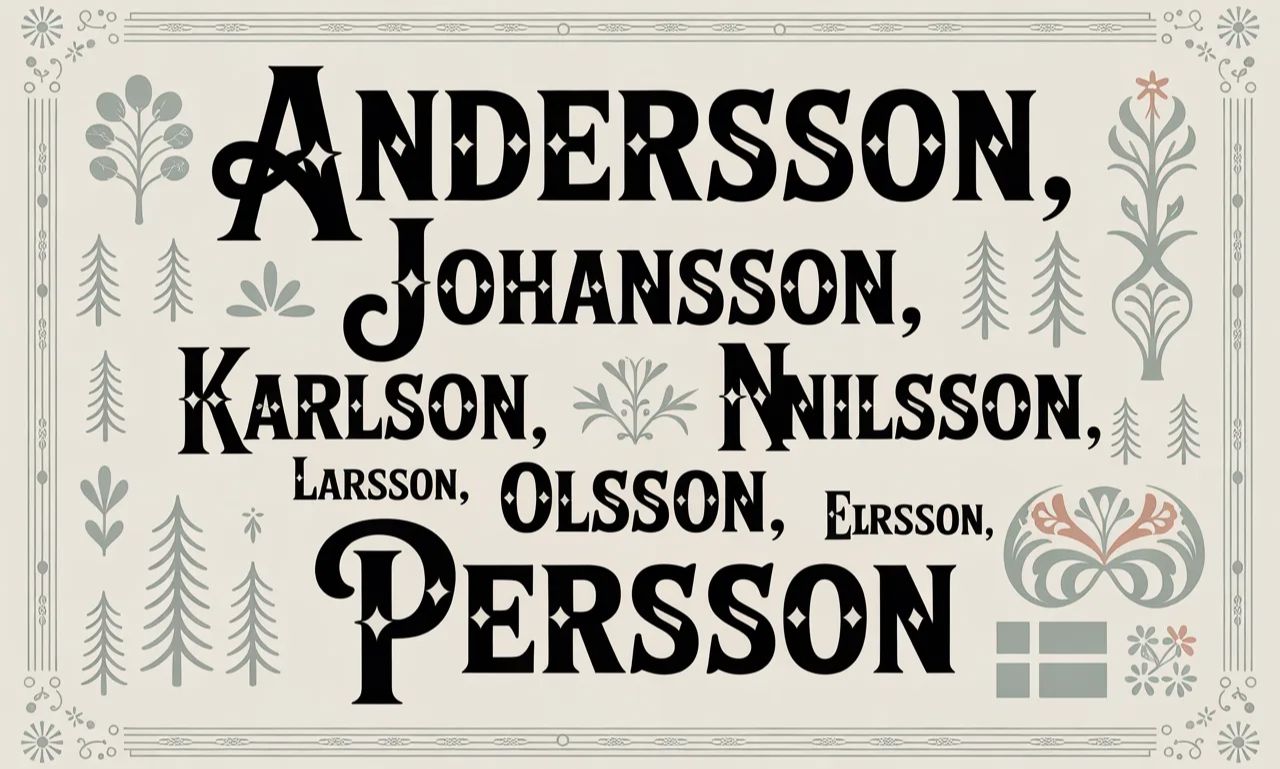

Discovering the story behind Swedish last names is like opening a dusty attic trunk filled with Viking heritage and genealogical treasures. These names aren’t just labels; they are a patronymic roadmap that traces how ancestral roots shifted from “son of” traditions into fixed family identifiers. By exploring their etymology, you connect deeply with the rugged, snow-dusted history of the Scandinavian landscape.
Have you ever wondered why some names sound like a rhythmic melody while others carry the weight of a noble shield? The secret lies in a cultural evolution that transformed simple farmers into holders of prestigious titles. Imagine uncovering a hidden lineage buried within a rare moniker—a discovery so intriguing it could rewrite your entire personal history overnight.
Modern naming conventions are evolving as people seek unique identities through botanical elements and nature-inspired suffixes. This linguistic shift reflects a modern era where heritable titles blend seamlessly with creative innovation. Understanding these naming laws is the key to mastering your family research and finding a permanent surname that truly resonates with your Nordic soul.
31 Common Swedish Last Names That Define Generations
For centuries, the Swedish identity was a moving target. Surnames weren’t anchored to houses, but to fathers, creating a rolling history of lineage. While the modern era has traded this fluidity for permanent family titles, the echoes of those original “sons” still define the national phonebook today.
In the cobblestone streets of Stockholm or the quiet reaches of Kiruna, these names act as a cultural heartbeat. Most originated from the patronymic tradition, where your identity was literally “the son of” the man who came before you.
“Tracing my lineage was like reading a map of men’s first names. My 4x great-grandfather was a Magnus, so his kids were Magnussons. It’s a simple, honest way to carry your ancestors with you.”
| Name | Meaning & Heritage |
| Andersson | Descendant of Anders; the gold standard of Swedish identity. |
| Johansson | Heir of Johan; a cornerstone name found in every province. |
| Karlsson | Son of Karl; carries a rugged, traditional strength. |
| Nilsson | Offspring of Nils; deeply rooted in southern agricultural history. |
| Eriksson | Lineage of Erik; a name shared by ancient kings and modern creators. |
| Larsson | Son of Lars suggests a steady, reliable family background. |
| Olsson | Descendant of Olof; a classic name that dominates the western heartlands. |
| Persson | Son of Per; an old-world variation of Peter with deep rural ties. |
| Svensson | Heir of Sven; so iconic it represents the “average” Swedish citizen. |
| Gustafsson | Son of Gustaf; carries a regal flair and timeless appeal. |
| Pettersson | Offspring of Petter; a rhythmic alternative to the more common Persson. |
| Magnusson | Lineage of Magnus; meaning “Great,” it implies a bold heritage. |
| Oskarsson | Son of Oskar gained massive popularity during the 19th-century monarchy. |
| Mattsson | Heir of Mattias; a staple name in both coastal and mountain regions. |
| Kristiansson | Son of Kristian reflects the historical influence of the church. |
| Bengtsson | Descendant of Bengt; a name that flourished in the southern plains. |
| Fredriksson | Son of Fredrik; often linked to families with a disciplined, orderly past. |
| Edvardsson | Offspring of Edvard; a sophisticated patronymic with a noble ring. |
| Håkansson | Lineage of Håkan; an ancient Viking-era name that survived the ages. |
| Alfredsson | Son of Alfred; rose to prominence during the industrial enlightenment. |
23 Nature-Inspired Swedish Last Names (And What They Really Mean)
When Swedes sought to distinguish themselves from the sea of “sons,” they turned their eyes toward the horizon. These surnames are literal paintings of the Nordic landscape—capturing the mist over a lake, the density of a birch forest, or the sharp peak of a granite mountain.
During the 1800s, many families “invented” their own names by combining two elements of nature. It was a way to claim a piece of the earth as a personal brand, moving away from ancestry and toward the environment.
“My last name is Björklund. Every time I say it, I picture the white bark of the birch trees behind my grandmother’s cabin. It’s more than a name; it’s a landscape.”
| Name | Meaning & Natural Connection |
| Lindberg | Linden tree + Mountain; a balance of soft foliage and hard stone. |
| Sjöberg | Lake + Mountain; captures the dramatic vistas of the Swedish coast. |
| Ekström | Oak + River; symbolizes enduring strength and constant movement. |
| Björklund | Birch + Grove; evokes the bright, airy forests of the north. |
| Lundgren | Grove + Branch; a poetic name for someone tied to the woods. |
| Holmström | Islet + Stream; suggests a peaceful life surrounded by water. |
| Blomqvist | Flower + Twig; a delicate, artistic name from the late 19th century. |
| Sandberg | Sand + Hill; mirrors the rolling dunes and coastal elevations. |
| Dahlström | Valley + River; a name that flows with the lowlands of the interior. |
| Skoglund | Forest + Grove; for those whose roots go deep into the timberlands. |
| Granberg | Spruce + Mountain; reflects the evergreen heights of the highlands. |
| Rosendahl | Rose + Valley; a romantic, picturesque name often chosen for its beauty. |
| Liljeblad | Lily + Leaf; a soft, botanical identifier with a touch of grace. |
| Falkenberg | Falcon + Mountain; implies a high vantage point and a sharp eye. |
| Hasselgren | Hazel Branch; connected to the fruitful bushes of the countryside. |
| Åkerlund | Field + Grove; signifies a transition from farming to the forest. |
| Strandberg | Beach + Mountain; where the rugged cliffs meet the crashing sea. |
| Engström | Meadow + River suggests a vibrant, fertile landscape full of life. |
| Bergkvist | Mountain + Twig; a contrast between the massive and the minute. |
| Sundqvist | Strait + Branch; reflects the narrow waterways of the archipelago. |
20 Royal, Noble & Old Swedish Last Names That Still Carry Legacy
In the halls of Swedish history, certain names carry a heavier resonance. These are the titles of knights, advisors to kings, and the military elite. Unlike common names, these were often granted as rewards for bravery or service, acting as permanent medals worn by entire families.
Noble names often avoided the “son” suffix entirely. Instead, they used heraldic imagery—shields, stars, and swords. To hold one of these names today is to carry a linguistic artifact of Sweden’s era as a European superpower.
“Having an ‘Old Noble’ name in a modern democracy is an interesting vibe. It’s a reminder that my ancestors stood on the front lines of history, for better or worse.”
| Name | Background & Historical Symbolism |
| Bernadotte | The current Royal House; originally of French Napoleonic origin. |
| Oxenstierna | “Ox Star”; one of the most powerful political dynasties in history. |
| Wrangel | A name synonymous with military genius and high-ranking generals. |
| Klingspor | Linked to the cavalry; the name literally refers to a “clinking spur.” |
| Trolle | A legendary name from the Middle Ages with a mythic, “troll-like” aura. |
| Fersen | Famous for courtly intrigue and close ties to the French monarchy. |
| De la Gardie | A French-descended noble line that shaped Swedish culture and art. |
| Adlercreutz | “Eagle Cross”; a title granted for exceptional valor on the battlefield. |
| Hammarskjöld | “Hammer Shield”; famously carried by global peacekeepers and poets. |
| Leijonhufvud | “Lion Head”; an ancient, high-ranking name of the landed gentry. |
| Sparre | Refers to a “rafter” in heraldry; one of the oldest clans in the realm. |
| Ehrencrona | “Crown of Honor”; a name bestowed upon those knighted for loyalty. |
| Gyldenstolpe | “Golden Pillar”symbolizes a family that acted as a support for the state. |
| Silfversparre | “Silver Rafter”; a variation of the Sparre name indicating a specific branch. |
| Stjernswärd | “Star Sword”; a poetic combination representing light and defense. |
| Rosenblad | “Rose Leaf”; a refined name belonging to the 19th-century elite. |
| Posse | A medieval powerhouse family with deep roots in the Swedish council. |
Swedish Last Names in America: 19 Anglicized Names with Nordic Roots
When Swedish pioneers stepped off the boats at Ellis Island or settled in the Midwest, their names often underwent a transformation. Whether it was to escape a “foreign” sound or simply to help a busy clerk, these surnames were streamlined, creating a bridge between the old world and the new.
The transition from “Swedish-American” to simply “American” is etched into the vowels of these names. A double ‘s’ was dropped here, a ‘j’ was swapped for a ‘y’ there, all in an effort to blend into the vast American tapestry while keeping a quiet link to the homeland.
“My great-grandfather arrived as ‘Sjöberg.’ Within a year in Minnesota, he was ‘Seaberg.’ He said it was easier to get a job when the boss could actually pronounce your name.”
| Original Swedish Name | Americanized Version | Meaning / Origin |
| Andersson | Anderson | “Son of Anders”; The most iconic Swedish-American name. |
| Johansson | Johnson | “Son of Johan”; Shifted to the most common English equivalent. |
| Karlsson | Carlson | “Son of Karl”; A simple C-swap to fit English phonetics. |
| Olsson | Olson | “Son of Olof”; Dropped a syllable for a punchier, American feel. |
| Nilsson | Nelson | “Son of Nils”; Adapted to sound like a native British-American name. |
| Eriksson | Erickson | “Son of Erik”; Added a ‘k’ for a more familiar English spelling. |
| Pettersson | Peterson | “Son of Petter”; Streamlined for easier spelling in records. |
| Gustafsson | Gustafson | “Son of Gustaf”; Retained the royal root with a softer ending. |
| Jönsson | Johnson/Jonson | “Son of Jön”; The umlaut ‘ö’ was often lost in translation. |
| Mattsson | Mattson | “Son of Mattias”; Dropped the double ‘s’ for simplicity. |
| Bengtsson | Benson | “Son of Bengt”; Sharply shortened for a modern US sound. |
| Oskarsson | Oscarson | “Son of Oskar”; A direct phonetic translation for the Midwest. |
| Håkansson | Hawkinson | “Son of Håkan”; Transformed to match how Americans heard the name. |
| Lundström | Lundstrom | “Grove Stream”; Dropped the Swedish accent over the ‘o’. |
| Bergqvist | Bergquist | “Mountain Twig”; The ‘v’ became a ‘u’ for better flow. |
| Sjöberg | Seaberg | “Sea/Lake Hill”; A literal translation of the Swedish meaning. |
| Skoglund | Skogland | “Forest Grove”; Often changed to sound like “land” or “country.” |
| Dahlström | Dahlstrom | “Valley Stream”; Kept the spelling but lost the Swedish pronunciation. |
| Holm | Holmes | “Islet”; Often gained an ‘es’ to mimic English surnames. |
Swedish Female & Male Last Names: 18 Surnames With Gendered Stories
Historically, a Swedish family wasn’t a single unit under one name; it was a collection of sons and daughters. This tradition of “gender-splitting” surnames creates a beautiful, if complex, family tree where siblings carry different markers of their father’s identity depending on their own gender.
While the 1901 Names Act forced everyone into a “son” surname for a century, modern Swedish law has reopened the door. Today, a new generation is reclaiming the “dotter” (daughter) suffix, honoring their mothers or fathers in a way that feels both ancient and progressive.
“I changed my name to ‘Annasdotter’ to honor my mother. It felt like reclaiming a piece of history that was taken away from women 100 years ago.”
| Female-Style (Patronymic) | Male-Style (Patronymic) | Root Name Meaning |
| Andersdotter | Andersson | “Daughter/Son of Anders” |
| Johansdotter | Johansson | “Daughter/Son of Johan” |
| Karlsdotter | Karlsson | “Daughter/Son of Karl” |
| Nilsdotter | Nilsson | “Daughter/Son of Nils” |
| Eriksdotter | Eriksson | “Daughter/Son of Erik” |
| Larsdotter | Larsson | “Daughter/Son of Lars” |
| Olofsdotter | Olsson | “Daughter/Son of Olof” |
| Persdotter | Persson | “Daughter/Son of Per” |
| Svensdotter | Svensson | “Daughter/Son of Sven” |
| Gustafsdotter | Gustafsson | “Daughter/Son of Gustaf” |
| Mårtensdotter | Mårtensson | “Daughter/Son of Mårten” |
| Bengtsdotter | Bengtsson | “Daughter/Son of Bengt” |
| Fredriksdotter | Fredriksson | “Daughter/Son of Fredrik” |
| Håkansdotter | Håkansson | “Daughter/Son of Håkan” |
| Oskarsdotter | Oskarsson | “Daughter/Son of Oskar” |
| Elisabetsdotter | Elisabetsson | “Daughter/Son of Elisabet” (Matronymic) |
| Lenasdotter | Lenasson | “Daughter/Son of Lena” (Matronymic) |
| Mariasdotter | Mariasson | “Daughter/Son of Maria” (Matronymic) |
20 Rare & Uncommon Swedish Last Names You’ve Probably Never Heard Of
Beyond the common and the nature-inspired lies a realm of names that are truly unique—some belonging to only a handful of people in the entire world. These are the results of rare military “soldier names,” creative inventions of the 1800s, or ancient regional dialects.
Choosing a rare name in Sweden is a statement of individuality. These names often break the rules of traditional grammar, blending unexpected imagery or archaic words that sound like music when spoken. They are the hidden treasures of Nordic nomenclature.
“I wanted something that stood out. I found an old name from my village that had died out in the 1920s and legally revived it. Now I’m one of only ten people with it.”
| Name | Meaning or Historical Origin | Country/Region |
| Drakenberg | “Dragon Mountain”; A bold, mythical creation. | Sweden (Noble) |
| Vintergatan | “The Milky Way”; Literally means “The Winter Road.” | Sweden (Invented) |
| Natt och Dag | “Night and Day”; One of Sweden’s oldest noble clans. | Sweden (Ancient) |
| Runeborg | “Rune Castle”; Evokes ancient Viking carvings. | Sweden (Rare) |
| Stålhammar | “Steel Hammer”; A classic “soldier name” for strength. | Sweden (Military) |
| Liljencrantz | “Lily Wreath”; A delicate, aristocratic identifier. | Sweden (Noble) |
| Silfverskiöld | “Silver Shield”; An archaic spelling of a knightly name. | Sweden (Legacy) |
| Ehrenblad | “Honor Leaf”; Combining status with the natural world. | Sweden (Noble) |
| Ljungqvist | “Heather Twig”; Refers to the purple heather of the moors. | Sweden (Nature) |
| Kämpe | “Warrior” or “Champion”; A short, powerful soldier name. | Sweden (Old Military) |
| Hökmark | “Hawk Field”; A geographic name from the northern coast. | Sweden (Northern) |
| Bielke | “Beam”; A name from one of the most powerful medieval houses. | Sweden (Medieval) |
| Almfeldt | “Elm Field”; A rare combination of tree and landscape. | Sweden (Rare) |
| Törngren | “Thorn Branch”; Suggests a sharp, resilient family lineage. | Sweden (Nature) |
| Gripenhielm | “Griffin Helmet”; High-fantasy imagery from the nobility. | Sweden (Noble) |
| Bratt | “Steep”; Refers to the rugged terrain of a family farm. | Sweden (West Coast) |
| Strömfelt | “Stream Field”; A melodic, aristocratic surname. | Sweden (Historical) |
| Örnblad | “Eagle Leaf”; A rare, high-flying natural pairing. | Sweden (Creative) |
| Roswall | “Rose Wall”; Likely derived from a farm surrounded by wild roses. | Sweden (Skåne) |
14 Swedish Last Names Starting with B, S, and Other Popular Letters
In the Swedish language, the letters ‘B’ and ‘S’ are particularly dominant. They often serve as the starting point for names that describe the physical world—mountains, streams, and groves. By categorizing names this way, we can see the rhythmic patterns that make Swedish surnames so distinctive and melodic.
“There’s a specific cadence to Swedish names—’B’ usually feels grounded and powerful, while ‘S’ flows like the water that surrounds our islands. You don’t just read these names; you feel the geography behind them.”
Starting with B
The letter ‘B’ is the heavy hitter of Swedish nomenclature. It frequently anchors names related to Berg (mountain) or Björk (birch), representing the solid, unyielding parts of the Scandinavian landscape.
| Name | Meaning & Nuance | Origin/Vibe |
| Bergström | “Mountain Stream”; A name of constant energy. | Sweden (Nature) |
| Björklund | “Birch Grove”; Evokes the iconic white forests. | Sweden (Classic) |
| Blomqvist | “Flower Twig”; A poetic, 19th-century invention. | Sweden (Artistic) |
| Bergqvist | “Mountain Twig”; A contrast of scale and detail. | Sweden (Common) |
| Broman | “Bridge Man”; Likely a name for a bridge keeper. | Sweden (Occupational) |
| Bratt | “Steep” or “Bold”; Refers to rugged cliffside farms. | Sweden (West Coast) |
| Bielke | “Beam”; An ancient, high-ranking noble title. | Sweden (Noble) |
Starting with S
The letter ‘S’ often introduces names tied to the water—Sjö (lake), Sund (strait), and Ström (river). These names reflect a nation of sailors, fishermen, and coastal dwellers who lived in harmony with the Baltic and North Seas.
| Name | Meaning & Nuance | Origin/Vibe |
| Sjöberg | “Lake Mountain”; The quintessential coastal view. | Sweden (Topographic) |
| Sundqvist | “Strait Branch”; Refers to the narrow sea passages. | Sweden (Coastal) |
| Skoglund | “Forest Grove”; Deeply tied to the timber industry. | Sweden (Rural) |
| Sandström | “Sand Stream”; Likely from a silt-rich riverbank. | Sweden (Nature) |
| Strömberg | “Stream Mountain”; Where the water meets the heights. | Sweden (Widespread) |
| Söderström | “Southern Stream”; A regional identifier. | Sweden (Geographic) |
| Silfverhjelm | “Silver Helmet”; A striking military/noble title. | Sweden (Noble) |
Frequently Asked Questions
What are the most common Swedish last names found today?
Most common surnames end in “-sson,” such as Andersson and Johansson. These traditional patronymic names still dominate the majority of modern Swedish family registries.
How did nature influence Swedish last names during the 19th century?
Families began adopting surnames inspired by the landscape, combining elements like “Berg” (mountain) and “Lind” (linden) to create unique, poetic, and non-patronymic identities.
Are there specific Swedish last names that indicate noble or royal heritage?
Yes, noble surnames often feature heraldic imagery like “Stiernhielm” (star helmet). These prestigious titles were historically granted by the monarch for exceptional military service.
Why did many Swedish last names change when immigrants moved to America?
To assimilate faster, many arrivals simplified their spellings. For example, “Sjöberg” often became “Seaberg” to ensure easier pronunciation and better employment opportunities abroad.
Can modern parents choose gender-specific “dotter” surnames for their children?
Absolutely. Current Swedish naming laws allow parents to revive the “dotter” suffix, offering a meaningful way to honor a daughter’s specific lineage and heritage.
Conclusion
Swedish surnames are living echoes of the past, bridging the gap between ancient Viking patronymics and the rhythmic beauty of the Nordic landscape. Whether they carry the “-sson” of a father’s legacy or the “berg” of a mountain peak, these names offer a profound sense of belonging that transcends time.
As modern Swedes reclaim “dotter” suffixes and invent rare new titles, the story of these identifiers continues to evolve. Each name is a doorway to a specific heritage—a way to honor those who came before while carving out a distinct path for the generations yet to follow.
Grayson Pike is a pop culture enthusiast and entertainment writer with a sharp eye for celebrity trends. He explores Hollywood stories, interviews, and behind-the-scenes insights, delivering engaging content with a unique voice. Grayson combines curiosity and expertise to keep readers informed and entertained in the fast-paced world of fame.
