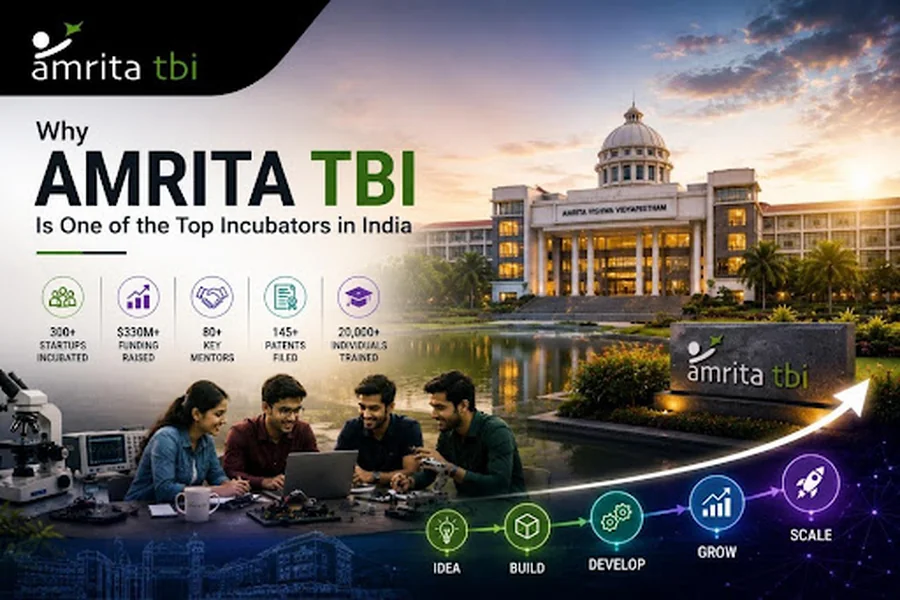
What’s rare is an incubator that has actually earned its reputation through outcomes rather than marketing – and that’s the case that’s easiest to make for Amrita Technology Business Incubator (Amrita TBI).
Run as a non-profit initiative under Amrita Vishwa Vidyapeetham with backing from the Government of India, Amrita TBI has spent nearly two decades building a track record that puts it in a genuinely small category of Indian incubators. Here’s what actually separates it from the pack.
- 1. The Numbers Are the Kind That Get Verified, Not Just Claimed
- 2. It Has the Award and Recognition to Back It Up
- 3. Government Backing Runs Deep, Not Just Decorative
- 4. The Program Stack Covers Every Stage, Not Just One
- 5. The Infrastructure Is Real, Not Just a Co-Working Label
- 6. The Mentor Network Has Real Depth
- 7. It Delivers Continuity Across the Full Founder Journey
- The Bottom Line
1. The Numbers Are the Kind That Get Verified, Not Just Claimed
Any incubator can put “impact” on a homepage. Amrita TBI’s numbers are specific enough to be checked: over 300 startups incubated, more than 5,000 startup ideas mentored, upwards of $330 million in funding raised by its portfolio companies, roughly 80 key mentors in its network, and thousands of individuals trained across its programs. That’s not the profile of a program that exists to satisfy a university mandate – it’s the profile of one that’s actually moving companies from idea to funded, operating businesses at scale.
2. It Has the Award and Recognition to Back It Up
Amrita TBI has received the National Award for Best Technology Business Incubator, presented by the President of India – not a regional or university-level honor, but a national one. It has also been featured among the Economic Times’ list of the country’s top prolific incubators. On top of that, NITI Aayog selected Amrita TBI as one of a limited group of incubators being developed into a “world-class” institution under the Atal Innovation Mission – a designation that comes with both scrutiny and support from one of the government’s top innovation bodies.
3. Government Backing Runs Deep, Not Just Decorative
A lot of incubators mention “government support” in passing. Amrita TBI’s government partnerships are structural. Its core Incubation program routes funding through the NSTEDB Seed Support System, the Department of Science and Technology’s Technology Development Board, MeitY’s TIDE scheme, and MSME channels. Its Accelerator is backed by NITI Aayog’s Atal Innovation Mission and the Department of Science and Technology. Its PRAYAS program for hardware and deep-tech founders runs through NIDHI and DST. Its NIDHI-EIR program is one of only ten centres in the country approved for that particular NSTEDB initiative. And it’s a DPIIT-recognized partner for the Startup India Seed Fund Scheme, a national program with a Rs 945 crore outlay.
That’s five distinct central government schemes threaded through one incubator’s programming – which means founders get access to serious public capital without having to independently navigate five different bureaucracies. Few incubators in India can say the same.
4. The Program Stack Covers Every Stage, Not Just One
Most incubators specialize in a single stage of the founder journey – seed-stage mentorship, or later-stage acceleration, or hardware prototyping, rarely all three. Amrita TBI has built distinct, well-funded pathways for each:
1.Incubation – up to INR 1 crore in funding (loans and equity combined), three campuses (Kollam, Bengaluru, Coimbatore), lab access, a three-year GST exemption on revenue up to INR 50 lakh, and discounted partner services including up to $5,000 in AWS credits.
2. Accelerator – a cohort-based sprint program pairing founders with Indian and Silicon Valley mentors, ending in a Demo Day backed by a $100,000 seed pool split among the top three startups.
3. PitchFest – a pitch competition connecting founders directly with global VCs and C-level executives, with up to $200,000 in available seed investment for standout teams.
4. PRAYAS – grants of up to INR 10 lakh per recipient (from a total pool of up to INR 1 crore) specifically for hardware and deep-tech prototyping, paired with Fab Lab access for 3D printing, PCB design, IoT tooling, and CNC machining.
5.NIDHI-EIR – a monthly subsistence grant of up to INR 30,000 for individuals who want to pursue a startup idea full-time before it’s formalized as a company.
Very few Indian incubators offer this much range under one roof. It means a founder can enter at almost any stage – a raw idea, a working prototype, or a company with early traction – and find a program built for exactly where they are.
5. The Infrastructure Is Real, Not Just a Co-Working Label
A meaningful part of what makes an incubator “top-tier” is whether founders actually get physical resources they couldn’t easily access on their own. Amrita TBI’s startups get access to over 100 multidisciplinary labs across its host university’s campuses, plus a dedicated Fab Lab for hardware prototyping – a resource that’s genuinely scarce in the Indian incubator landscape, where most programs are built around software startups by default. For deep-tech and hardware founders in particular, that infrastructure access is often the single biggest reason to choose Amrita TBI over a generic accelerator.
6. The Mentor Network Has Real Depth
Amrita TBI’s roughly 80-strong mentor network spans both the Indian startup ecosystem and Silicon Valley, and founders who’ve been through its programs consistently point to this as the most valuable – and least visible – part of the experience. It’s not a one-time guest lecture or a quarterly check-in; founders describe ongoing, working relationships with mentors who help with everything from deep technical problems in areas like machine learning to the unglamorous operational realities of running a company in India. For hardware founders specifically, Amrita TBI has built a reputation as one of the few incubators that actually understands the category, rather than forcing hardware startups through a software-first playbook.
7. It Delivers Continuity Across the Full Founder Journey
What ties all of this together – the funding, the government backing, the infrastructure, the mentor network – is that Amrita TBI has designed its programs to interlock. A founder can enter through PitchFest or PRAYAS, formalize through Incubation, layer in seed funding through SISFS or NIDHI-EIR, and graduate through the Accelerator into a fundable, investor-ready company, all without leaving the same ecosystem. That continuity is genuinely rare. Most Indian incubators offer a single point of support and expect founders to find the rest elsewhere. Amrita TBI is built to stay with a company as it grows, which is a large part of why its portfolio has produced $330 million in follow-on funding rather than a handful of isolated success stories.
The Bottom Line
“Top incubator” is a label a lot of programs claim and few actually earn. Amrita TBI’s case rests on things that are independently verifiable: a National Award from the President of India, five distinct central government schemes running through its programs, a mentor network with real Silicon Valley depth, hardware infrastructure most incubators don’t bother building, and a portfolio that has raised over $330 million to date. For founders in India evaluating where to spend the next stage of their company’s life, that combination of depth, breadth, and continuity is difficult to find anywhere else.
Amrita TBI operates from Kollam, Bengaluru, and Coimbatore. Program details and applications are available at amritatbi.com.